
If you walk into a well-managed warehouse, you’ll often see an interesting phenomenon: At the entrance, next to the time clock, near the forklift aisle, or at the entrance to the picking area, there’s always a neatly arranged row of personal protective equipment (PPE).
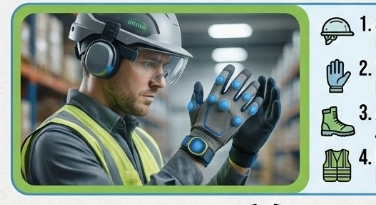
This could be gloves, goggles, hard hats, reflective vests, non-slip shoe covers, or even an entire wall of PPE.
Many people might initially think this is simply for “easy access.” However, in the safety management logic of many companies, this arrangement reflects a whole set of behavioral science, management experience, and safety engineering considerations.
In short—placing PPE in the most prominent position is actually a very effective safety management strategy.
Today, we’ll discuss from several perspectives why this seemingly simple detail is so common in the warehousing and logistics industry.
I. The Simplest Reason: Seeing Makes Us Remember to Use Them
Many safety managers say the same thing:
“The biggest enemy of personal protective equipment (PPE) isn’t quality, it’s being forgotten.”
In many warehouse environments, employees face a large amount of repetitive but fast-paced work every day:
- Picking
- Loading and Unloading
- Packaging
- Forklift Transportation
- Sorting
When the work pace quickens, people’s brains automatically enter an efficiency-first mode. In this situation, many seemingly simple steps are easily overlooked.
For example:
- “I’m only moving two boxes today, it’s okay not to wear gloves.”
- “I’m just going in to get something, I don’t need to wear goggles.”
- “The safety helmet is in the tool cabinet, it’s too troublesome to walk back and forth.”
If PPE is placed in an inconspicuous place, or even requires special searching, these “small acts of laziness” will increase.
However, when PPE is placed directly next to the entrance or work area, the situation is completely different.
Upon entering, employees immediately see:
- A row of gloves
- A row of safety goggles
- A whole box of reflective vests
This visual cue triggers an unconscious action:
“Grab one.”
Many times, safety habits are gradually formed this way.
II. Behavioral Psychology: Humans are easily influenced by “environmental cues”
Why is “visibility” so important?
This relates to a concept in behavioral psychology—environmental cues.
Simply put, many human behaviors are not entirely rational but are influenced by the surrounding environment.
For example:
- Putting fruit on the table makes people more likely to eat it.
- Putting a water glass on the desk makes people more likely to drink water.
- Putting running shoes by the door makes people more likely to go for a run.
The same logic applies to safety protection.
If a warehouse stores personal protective equipment as:
- locked in a cabinet
- placed in the office
- stored in a corner of the warehouse
then the probability of employees using it will significantly decrease.
However, if you place them:
- at the entrance
- next to the work area
- in a major thoroughfare
then the probability of people using them will increase significantly.
This isn’t because employees suddenly become more “disciplined,” but because the environment is constantly reminding them.
Many excellent warehouse managers are actually very good at utilizing this kind of environmental design.
III. Reducing the Problems of “Borrowing” and “Not Being Able to Find”
In many warehouses, there’s a very real phenomenon:
Some personal protective equipment (PPE) is particularly prone to “disappearing.”
For example:
- gloves
- goggles
- safety knives
- reflective vests
It’s not that someone deliberately takes them, but because:
- they are used frequently
- people borrow them temporarily
- people can’t find their own equipment
When PPE is placed in a fixed and conspicuous location, this situation will be significantly reduced.
The reason is simple:
- people know where to take it
- and where it should be put back
- new employees can also find it quickly
many warehouses set up a PPE Station (Personal Protective Equipment Area) for this reason.
When PPE has a clear location, management becomes much simpler.
IV. Raising Safety Awareness, Not Just Relying on Rules
Many companies encounter a challenge in safety management:
The rules are comprehensive, but enforcement is inconsistent.
For example:
The regulations are clearly stated:
Personal protective equipment (PPE) must be worn when entering the warehouse.
However, in practice, some people will occasionally not wear it.
In this case, simply relying on penalties is often ineffective.
In contrast, some companies adopt a more “flexible” approach, such as:
- Placing PPE in the most conspicuous location
- Placing reminder signs nearby
- Using colors to distinguish different equipment
This approach continuously reinforces the message:
“The working environment here requires protection.”
When employees see this equipment every day, safety awareness will gradually develop.
Over time, wearing PPE will become a habit, rather than a mandatory rule.
V. Easier and Quicker Use in Emergency Situations
In a warehouse environment, some PPE is not used every day, but it is crucial in specific situations.
For example:
- Safety goggles
- Cut-resistant gloves
- Non-slip shoe covers
If these items are placed in a hard-to-find location, it could waste time if needed.
However, when they are placed in a prominent location:
Employees can find them within seconds.
For some emergencies, this time difference is crucial.
This is why many warehouses have:
- PPE cabinets
- Safety equipment racks
- Protective equipment walls
What may seem like simple placement actually reflects considerations for emergency response efficiency.
VI. Making it easier for new employees to integrate into the safety culture
New employee training is always an important part of warehouse management.
However, even the most detailed training cannot cover all the details.
Often, new employees learn by observing their surroundings.
When employees enter the warehouse and see:
- Everyone is getting gloves at the entrance
- Everyone is wearing reflective vests
- PPE is neatly arranged
They will naturally understand one thing:
“Safety is highly valued here.”
Conversely, if PPE is scattered everywhere, new employees will find it difficult to develop proper safety habits.
Therefore, the way PPE is arranged is actually part of the company culture.
VII. Good safety management is often hidden in these small details
When many people talk about warehouse safety, they often think of:
- Safety training
- Equipment maintenance
- Operating procedures
These are certainly very important.
However, in actual management, many truly effective safety improvements often come from seemingly insignificant details.
For example:
- Are PPEs easily accessible?
- Are they placed in designated locations?
- Are they easily visible?
These designs seem simple, but they can significantly improve the utilization rate of protective equipment.
In long-term operation, these details will gradually accumulate and ultimately affect the overall safety level of the warehouse.
Conclusion
Next time you walk into a warehouse and see neatly arranged personal protective equipment (PPE) at the entrance, you might have a different understanding.
It’s not just about “easy access.”
It’s a proven management approach:
Through environmental design, safety becomes a natural behavior.
Often, safety isn’t maintained by complex rules, but by simple and effective habits.
Placing PPE in the most prominent position is the beginning of these habits.
Leave a Reply