
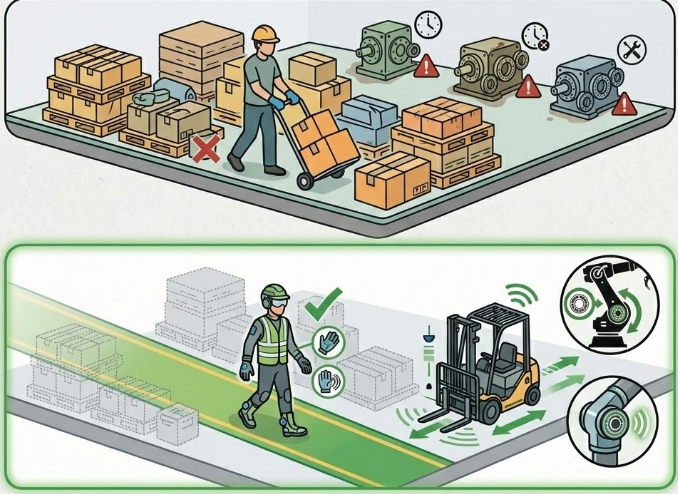
If you’ve recently visited some modern, large warehouses, you’ll notice a significant change: the floor markings are much clearer, forklift aisles, pedestrian walkways, loading/unloading areas, and buffer zones are neatly divided, and even turning and waiting areas are clearly marked. Many companies are not only redesigning their warehouse layouts but also specifically designing so-called “safety flow paths.”
Many people might wonder when they first hear this term: Isn’t a warehouse just shelves, forklifts, and goods? Why design “flow paths” specifically?
In fact, in modern logistics systems, safe flow paths have become a crucial part of warehouse safety management. As the logistics industry expands, automation equipment increases, and operational efficiency demands rise, more and more large warehouses are realizing that warehouse accidents are often not equipment problems, but rather flow path problems.
This article will take you deeper into why more and more companies are redesigning their warehouse safety flow paths and the scientific logic behind these changes.
What is Warehouse “Safety Flow Path”?
Simply put, safety flow design is designing safe movement paths for different objects within a warehouse.
In a typical warehouse, the main moving objects include:
- Forklifts
- Personnel
- Pallets and goods
- Automated material handling equipment
- Transport vehicles
If these objects move haphazardly within the same space, chaos and even danger will result.
Therefore, the core principle of safe workflow design is:
To allow different roles to move along different paths, reducing intersections and conflicts.
Common safe workflows include:
- Forklift lanes
- Pedestrian walkways
- Goods storage areas
- Loading and unloading areas
- Turn buffer zones
- Waiting areas
By rationally dividing these areas, warehouse operations can be more orderly, significantly reducing the risk of accidents.
Why are more and more warehouse accidents related to workflow?
Many warehouse accidents appear to be operational errors, but in reality, they are often rooted in problems with workflow design.
In the logistics industry, the most common warehouse accidents include:
1. Collisions between personnel and forklifts
This is one of the most common accidents in warehouses. Often, the problems aren’t driver error, but rather due to:
- Unclear pedestrian walkways
- Mixed traffic flow between forklifts and pedestrians
- Too many blind spots
When people suddenly appear in the forklift’s path, even with a quick driver reaction, it may be too late to brake.
2. Accidents in Turning Areas
High warehouse shelves and narrow aisles often create blind spots for forklifts when turning.
Without:
- Speed reduction zones
- Turn warning lines
- Reflective markings
Drivers often only notice people or goods ahead when turning at high speed.
3. Temporary Stacking Causing Congestion
Many warehouses temporarily stack goods alongside aisles to improve efficiency.
This leads to two problems:
- Narrowed aisles
- Obstructed visibility
Ultimately preventing forklifts from moving properly, and even causing collisions.
These problems are essentially related to chaotic traffic flow.
The development of e-commerce logistics has exacerbated traffic flow issues.
In the past, traditional warehouse operations had a relatively stable pace and slow goods flow. However, with the development of the e-commerce industry, the intensity of warehouse operations has increased significantly.
For example, in a large e-commerce warehouse:
- Tens of thousands, even hundreds of thousands of orders are processed daily.
- Forklifts move back and forth at extremely high frequency.
- Pickers’ speed is constantly increasing.
In this situation, if the workflow design is unreasonable, the following will occur:
- Forklift congestion
- Frequent personnel crossing aisles
- Mixed picking and transport areas
This not only affects efficiency but also increases safety risks.
Therefore, many large warehouses often redesign their safety workflow systems before upgrading equipment.
New Challenges in the Era of Human-Machine Collaboration
In recent years, more and more warehouses have begun to introduce automated equipment, such as:
- Automated Guided Vehicles (AGVs)
- Automated Sorting Systems
- Automated Conveyor Lines
These devices improve efficiency but also bring new safety challenges.
For example:
AGVs typically operate along fixed paths. If personnel frequently enter their operating area, it may lead to:
- Robot emergency stop
- Decreased equipment efficiency
- Personnel being collided with by the equipment
Therefore, many warehouses have begun to design separate operating areas for robots and use:
- Ground warning lines
- Guard barriers
- Safety gates
To ensure a safe distance between humans and machines.
This is also a key reason for the redesign of workflow in modern warehouses.
How to redesign safe workflow in large warehouses?
Modern warehouse safety workflow design typically follows several basic principles.
1. Separation of People and Vehicles
This is the most important principle.
Common practices include:
- Providing separate passageways for personnel
- Marking separate lanes for forklifts
- Putting warning signs at intersections
At points where people and vehicles intersect, many warehouses also install:
- Convex mirrors
- Warning lights
- Speed reduction signs
This effectively reduces the occurrence of accidents.
2. Setting up buffer zones
In high-traffic areas, such as:
- Loading and unloading areas
- Sorting areas
- Main aisles on racks
Buffer zones are usually set up to allow forklifts to slow down before entering the main aisles.
Buffer zones can be marked using:
- Ground markings
- Bollards
- Ground warning tape
3. Clearly defining turning areas
Forklift turning is a high-risk area for accidents, therefore modern warehouses typically:
- Increase turning space
- Set up speed reduction markings
- Increase reflective warnings
This helps drivers anticipate their routes.
4. Visual Management
Visual management uses color and signage to make information immediately clear.
For example:
- Yellow line: Forklift aisle
- Green line: Personnel aisle
- Red zone: Hazardous area
This method is not only intuitive but also helps new employees quickly familiarize themselves with the warehouse environment.
Why does safe workflow design actually improve efficiency?
Many companies initially worry that strictly defining workflow will reduce operational efficiency.
However, practice has shown the opposite.
When warehouse workflow is clear:
- Forklifts don’t need to slow down frequently to avoid obstacles.
- Personnel walking routes are more direct.
Aisles are less likely to be blocked.
The end result is often:
Higher efficiency and fewer accidents.
Many logistics companies have even seen a 10% to 20% increase in warehouse efficiency after redesigning their workflow.
The Role of Protective Equipment in Safe Workflow
Protective equipment also plays a crucial role in safe workflow design.
For example:
Ground warning lines
Used to mark:
- Pedestrian walkways
- Forklift aisles
- Hazardous areas
Bumper guardrails
Used to protect:
- Shelves
- Equipment
- Walls
To prevent damage from forklift collisions.
Guard posts
Installed at:
- Posts
- Corners
- Entrances and exits
To reduce impact damage.
These seemingly simple facilities are actually important components of a warehouse safety system.
Future Trends in Warehouse Safety Flow Design
With the development of the logistics industry, warehouse flow design is constantly being upgraded.
Future trends include:
Intelligent monitoring systems
Using cameras and AI to identify:
- Hazardous behaviors
- Reminding personnel to avoid them
- Monitoring aisle congestion
Intelligent warning devices
Automatically triggering warning lights or sound alerts when a forklift approaches an intersection.
Dynamic flow management
Optimizing warehouse routes through data analysis to improve efficiency.
These technologies will further enhance warehouse safety levels.
Conclusion
Warehouse safety has always been an important topic in the logistics industry, and flow design is gradually becoming the core of safety management. More and more large warehouses are redesigning their safety traffic flow, not because of a pursuit of “formality,” but because they’ve discovered that:
Many accidents are not due to equipment problems, but rather to path design issues.
When personnel, forklifts, goods, and equipment move frequently within the same space, a clear safety traffic flow acts like an “invisible traffic rule,” making the entire warehouse operation smoother.
In the long run, a well-designed traffic flow not only reduces accidents but also improves efficiency and reduces losses.
This is why more and more companies are realizing that warehouse safety begins with those few lines on the floor.
Leave a Reply