
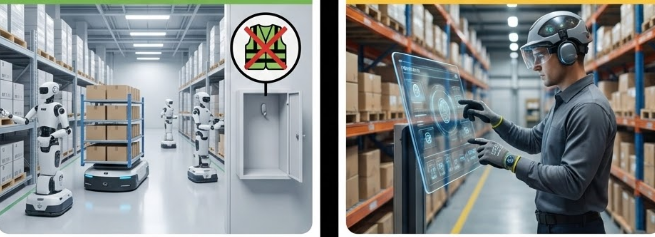
In recent years, the warehousing and logistics industry has seen phenomenal growth—automation, intelligence, and digitalization are constantly breaking efficiency records. From AGV robots to automated sorting systems, from unmanned forklifts to full-scene visual monitoring, the proportion of “people” in warehouses seems to be decreasing. But this raises a question:
As automation and intelligent technologies increasingly replace manual operations, will personal protective equipment (PPE) still have a market? Will it be phased out like old-fashioned safety helmets?
The answer is no—and behind this question lies a core issue that is reshaping corporate safety culture and future employment patterns.
I. Is Automation Really “Replacing People”?
Let’s clarify a common misconception:
Automation ≠ Humans Disappear
Automation and robots primarily perform three types of tasks:
Replacing repetitive, physically demanding tasks
For example, repetitive handling, reciprocating loading and unloading, and low-value-added loading and unloading.
Improving Efficiency and Consistency
Machines can operate continuously, reducing human error.
Reduce human intervention in high-risk scenarios
For example, at heights, in confined spaces, and in areas with high forklift traffic.
However, it is by no means intended to replace all human labor.
Modern warehouse automation systems are essentially “Human-Robot Collaboration (HRC)”:
Humans are responsible for judgment, exception handling, and decision-making;
machines are responsible for repetitive execution.
The most likely future is a collaborative working model of humans and intelligent systems, rather than a complete withdrawal of humans from the workforce.
II. Automation Doesn’t Eliminate Safety Equipment; Instead, It Redefines Its Value
1) Automation Introduces New Risk Scenarios
The types of risks in automated warehouses differ from those in traditional warehouses. It’s not simply about reducing accidents, but rather about risk migration and morphological changes:
Traditional Warehousing Risks New Risks in Automated Warehousing
* Muscle Injuries Caused by Manually Handling Heavy Objects
* Collision Risk in Human-Machine Mixed Areas
* Slips and Falls
* Collisions Caused by Robot Navigation Errors
* Forklift Scratches
* AGV Reaction Delays and Path Conflicts
* Improper Loading and Unloading
* Robotic Arm Misjudging Abnormal Material Forms
For a Visual Example:
- An AGV Encounters an Obstacle During Navigation
- System Judgment Delay or Sensor Misjudgment
- Collisions May Occur When Personnel Are Nearby
This isn’t a low-probability science fiction scenario, but a real risk pattern recorded in industry field research reports.
Therefore, automation doesn’t bring “zero risk,” but rather new types of risks plus different protection needs.
III. What are the “Essential” Safety Equipment in Automated Warehouses?
As technology upgrades, personal protective equipment (PPE) doesn’t disappear—it simply evolves and becomes more “intelligent.”
1. High-Visibility Smart Vest (with Sensors)
- Built-in RFID/Bluetooth/UWB positioning
- Able to interact in real-time with AGVs and intelligent facility systems
- Provides early warnings in areas where people and machines coexist
Why is it important?
Traditional reflective vests only make people more visible, but smart vests allow machines to see people.
2. Collision-Proof Smart Safety Helmet
- Combined with a positioning module, it automatically slows down/avoids when a person approaches.
- Works with visual AI to enhance collision prevention capabilities.
These are not traditional PPE (Personal Protective Equipment), but rather human-machine collaborative PPE.
3. Cut-Resistant Tactile Gloves
Even with increased automation, many operations still require human intervention, such as:
- Manually sorting abnormal orders
- Handling unidentifiable foreign objects
- Inspecting malfunctioning equipment
In these scenarios, finger dexterity and tactile feedback are crucial. Traditional, heavy gloves are actually unsuitable.
4. Contextualized Soles (Dynamic Anti-slip + Pressure-Sensitive Caution)
Automated floor display systems, in conjunction with foot contact sensing modules, can:
- Issue dynamic anti-slip cues along the robot’s path
- Provide slight vibrations to alert the wearer
These smart shoes are more of an “extension of the sensing layer,” not simply a “non-slip sole.”
IV. Automation Ushers in the “Intelligent Era” for Personal Protective Equipment (PPE)
We often say, “Technology makes simple things complicated, and complicated things simple.”
In an automated environment, PPE has evolved from passive protection to active assistance:
Passive Protection → Active Sensing
Past PPE provided passive protection:
- Helmets only absorbed energy upon impact
- Vests only reflected light
- Gloves only protected against scratches
Now it has become:
- Real-time location tracking and machine sharing
- Dynamic risk warnings
- Integration with intelligent systems to reduce accident probability
Single Equipment → Integrated System
PPE is no longer just a “single piece of equipment,” but part of a human-machine risk control system:
Human + Intelligent PPE + AGV/Visual AI + Safety Management System
Risk Perception → Warning → Automatic Intervention
This means:
The same intelligent vest is not just a wearable item, but also… Risk Sensing Nodes
V. Human-Machine Hybrid Risk Management in the Era of Automation: A Three-Layer Protection Strategy
If you are currently upgrading or preparing to upgrade your warehouse to an automated system, here is a “Future Warehouse Safety Framework”:
Layer 1: Environmental Perception and Isolation
- Define human-machine mixed zones
- Use laser fencing + visual perception systems
- Standardize ground markings and path planning
The perception boundaries of automated equipment will never be perfect; humans can never be completely excluded from “blind spots.”
Layer 2: Intelligent PPE
- Personal protective equipment with positioning and proactive early warning capabilities
- Integrated with Warehouse Execution Systems (WES/WMS)
- Gloves, shoes, and vests should all be included in the data system
In the past, PPE was the “last line of defense”; in the future, it should become the most advanced risk perception layer.
Layer 3: Data-Driven Risk Optimization
- Import PPE data into the safety analysis system
- Statistics on human-machine interaction frequency, proximity incidents, and warning frequency
- Optimize path planning and personnel scheduling
For example:
Indicators | Real-time Collection | Purpose
Personnel/Robot Approach Count | Location System | Adjust Passage Priority
Danger Approaches Without Alarms | Helmet/Vest Data | Enhance Isolation Strategies
High-Risk Events During Work Hours | System Log Fusion | Adjust Shifts and Protection Strategies
VI. Five Common Misconceptions About “Personnel Safety Equipment Will Be Eliminated”
Let’s break down the five most common misconceptions in the industry:
Misconception 1: The more automation, the less protection people need.
Fact: The more machines there are, the more effective and intelligent protection strategies we need.
Automation is not “zero-risk scenarios,” but rather “risks changing from explicit to implicit.”
Myth 2: Machine vision is more reliable than human eyes, so PPE is unnecessary.
Fact: Machine vision has its advantages, but:
- Changes in lighting can interfere with sensors.
- Robots may experience software malfunctions.
- Human intervention is still necessary in emergency scenarios.
Humans remain the most critical risk variable in any situation.
Myth 3: More intelligent means more expensive and more complex.
Fact: The cost of intelligent PPE is not simply an additive cost, but rather a reduction in overall safety costs plus a decrease in accident losses.
In the long run, it is the optimal solution for risk management costs.
Myth 4: Automated systems are sufficient for safety capabilities.
Fact:
The goal of automated systems is efficiency.
Safety is an independent value module that requires a professional combination strategy.
Myth 5: Automation is only useful for large enterprises
In fact:
Automation technology and smart PPE have already entered the deployment range for small and medium-sized warehouses, especially modular robots, positioning vests, and low-cost visual monitoring.
The ROI of automation + smart PPE is also considerable for small and medium-sized warehouses.
VII. Future Outlook: What will Occupational Safety and Health Products look like?
Trend 1: From Passive to Proactive
Equipment transforms from protection into sensing nodes, protecting not only people but also the stable operation of the system.
Trend 2: Visualization and Data Integration
PPE data will be incorporated into the warehouse safety big data system, ensuring that safety incidents are no longer unrecorded.
Trend 3: PPE and Digital Twin Collaboration
In digital twin scenarios, the behavior of every employee and robot can be traced back and predicted.
Trend 4: Personalized Protection Configuration
Based on employee habits and task types, a “dynamic PPE kit” configuration strategy is developed.
VIII. Conclusion: Automation is not the end, but an evolution.
The development of automation will not make personal protective equipment (PPE) “obsolete” or “unemployed.”
On the contrary, it is redefining the value of PPE:
It’s not just PPE (Personal Protective Equipment),
but H-PPE (Human-machine Protective & Predictive Equipment).
This is a new era of passive protection → proactive sensing → risk collaboration → data-driven.
The security of future warehouses isn’t a protective ring built from stacked individual pieces of equipment, but rather:
A proactive risk defense network jointly constructed by people + equipment + systems + data + smart PPE
If you are implementing automation upgrades, the most critical question isn’t:
Will personal protective equipment (PPE) become obsolete?
But rather:
Are you prepared for a “next-generation security system” that collaborates with automation systems?
Leave a Reply