
As more and more warehouses deploy robots, automated sorting systems, and intelligent scheduling platforms, a question is quietly circulating in the industry:
“Since machines are becoming increasingly intelligent, do people still need so many personal protective equipment (PPE)?”
In Amazon’s automated warehouses, mobile robots move between shelves;
In JD.com’s “unmanned warehouses,” orders require almost no human intervention from receiving to sorting;
In Tesla’s Gigafactory, robotic arms work in tandem with conveyor lines.
It seems that humans are slowly withdrawing from the workforce.
But the reality is far more complex than simply “machines replacing human labor.”
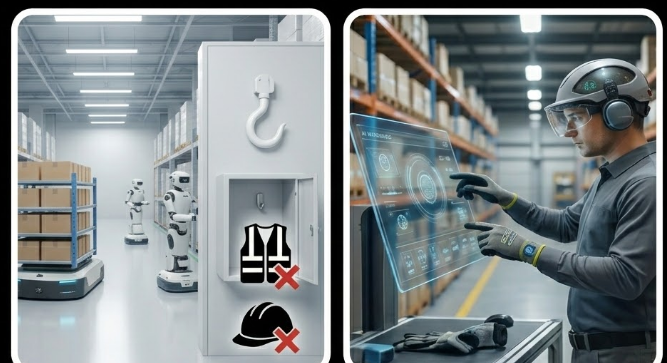
Today, let’s discuss: In the era of AI warehouses, will PPE (Personal Protective Equipment) disappear or be upgraded?
I. Are AI warehouses really “safer”?
The core goal of automated warehousing is to improve efficiency, reduce human error, and lower accident rates. Theoretically, this is indeed true.
- Robots don’t drive while fatigued.
- Systems can automatically limit speed.
- Visual recognition can provide early warnings.
But the reality is—the types of risks have changed, they haven’t disappeared.
In the past, risks primarily stemmed from human-to-human collisions; now, risks have shifted to the uncertainties of human-machine collaboration.
For a simple example:
In traditional warehouses, you worry about forklift drivers’ blind spots;
In automated warehouses, you need to worry about AGV (Automated Guided Vehicle) path planning blind spots, temporary obstacle recognition errors, and network latency.
Technology reduces the “probability” of accidents, but it changes the “form” of accidents.
This means: Safety equipment (SPE) hasn’t decreased, but has become more targeted.
II. What changes have occurred in warehouse risks in the AI era?
If you work in warehouse management, you may have already noticed several trends:
1️⃣ Changing Noise Environment
Robot operation, conveyor belts, and automated sorting systems continuously generate sustained mid-to-high frequency noise.
This noise is not bursty but rather “long-term cumulative.”
This makes hearing protection go from “optional” to “long-term necessity.”
2️⃣ More Complex Ground Environment
Automated warehouse floors are often:
- Epoxy flooring
- High-precision leveled surfaces
- Multi-zone markings
However, the problems are:
- Frequent robot operation leads to faster floor wear
- Increased cleaning frequency results in longer periods of dampness
- Marking lines wear out more frequently
This directly affects:
- The choice of anti-slip shoes
- The visibility of reflective vests
- The durability of floor warning tape
Safety shoes are no longer just about “impact protection,” but also about “anti-slip + anti-static + comfortable for long-term walking.”
3️⃣ More Prominent Static Electricity Issues
With numerous automated devices and complex electrical systems, static discharge becomes a hidden risk.
In high-density electronic warehousing environments, anti-static shoes and gloves are no longer exclusive to electronics factories but are increasingly being adopted in smart warehouse scenarios.
4️⃣ Increased Night Shift Ratio
AI systems can operate 24/7, which means:
- Night shifts are becoming the norm
- Changes in lighting conditions
- Increased demand for reflective materials
Reflective vests, nighttime visibility markings, and lightweight helmets are becoming increasingly important in smart warehouses.
III. Will PPE “Disappear”?
Many people believe that with more robots and fewer people, PPE consumption will naturally decrease.
But the reality is:
- 👉 Fewer frontline operators
- 👉 More maintenance engineers
- 👉 More equipment inspectors
- 👉 More data maintenance personnel
The job structure has changed, and so have the protection needs.
In the past, you needed heavy, abrasion-resistant gloves;
Now you may need more of—
- Anti-static precision operation gloves
- Lightweight safety shoes
- Highly comfortable, breathable, and reflective vests
- Noise-canceling earmuffs
This isn’t a “reduction,” but an “upgrade.”
IV. Will future PPE become “intelligent”?
This is a very real question.
Current trends include:
- Safety helmets with built-in sensors
- Safety shoes that record fall data
- Reflective vests with location tracking capabilities
In the United States, organizations like the Occupational Safety and Health Administration (OSHA) have been continuously focusing on safety management in the context of new technologies in recent years.
Future PPE may feature:
- Real-time location tracking
- Environmental monitoring
- Collision warning
- Temperature monitoring
But interestingly—
The more high-tech the warehouse, the more indispensable basic protection becomes.
Technology can reduce accidents, but it cannot completely replace “physical protection.”
V. Why do AI warehouses actually need “standardized PPE management” even more?
Automated warehouses have one characteristic:
High speed and precise processes.
This means:
- Once an accident occurs, the impact chain is longer
- Higher equipment downtime costs
- Greater indirect losses from safety incidents
- Therefore, companies often have stricter safety standards.
You will find:
- Reflective clothing levels are more clearly defined.
- Safety shoe standards are clearer.
- Glove classifications are more detailed.
- PPE distribution processes are more standardized.
To some extent, the higher the automation and the more refined the management, the less likely occupational safety equipment (OSE) will be “randomly selected.”
VI. What will truly “disappear”?
Not OSEs themselves.
But rather:
- Low-quality products
- Protection not matching the job requirements
- A procurement logic based solely on price
In the era of smart warehousing, companies are more concerned with:
- Lifespan
- Comfort
- Employee cooperation
- Long-term costs
If an employee is willing to wear a pair of shoes every day, its value far exceeds that of a cheap but unused product.
VII. PPE Upgrade Directions in the AI Warehouse Era
Based on current trends, several directions can be foreseen:
✔ Lightweight
Long-term inspection and maintenance operations require higher comfort levels.
✔ Multifunctional Integration
Anti-slip + anti-static + wear-resistant become combined requirements.
✔ High Visibility
In human-machine hybrid operation environments, visibility is key.
✔ Sustainable Materials
Under the trend of environmental protection, recyclable materials are beginning to enter the PPE (Personal Protective Equipment) field.
VIII. In Conclusion: It’s not PPE that’s disappearing, it’s “old thinking”
AI warehouses won’t make PPE disappear.
They will only eliminate:
- Unprofessional configurations
- Unscientific selections
- Management models that neglect safety
When robots move rapidly through the warehouse, the role of humans becomes:
- Managers
- Maintainers
- Collaborators
And the core keyword of the collaborative era is only two words:
Safety.
Technology makes efficiency higher,
but only suitable PPE can make efficiency “sustainable.”
FAQ
Q1: Do automated warehouses still need PPE?
Yes. Even in AI-driven warehouses, workers still face risks such as noise, static electricity, slip hazards, and human-robot interaction. PPE remains essential, though it may evolve in design and function.
Q2: What type of PPE is needed in automated warehouses?
Common PPE includes anti-slip safety shoes, anti-static gloves, high-visibility vests, hearing protection, and lightweight safety helmets.
Q3: Will robots eliminate workplace injuries?
Robots reduce certain types of accidents, but they also introduce new risks related to system errors, maintenance work, and human-machine collaboration.
The conclusion is simple:
AI warehouses will not make PPE disappear.
It will only make PPE more professional, more comfortable, and more intelligent.
If past PPE was “passive protection,”
the future PPE will become part of an “active safety system.”
And this is the upgrade direction that truly deserves attention.
Leave a Reply