
—If you think it’s just “that hard thing on the toe,” you’re seriously underestimating it.
I. Let’s start with a potentially unpleasant truth:
Most people first notice a toe cap not because of safety, but because of pain.
Not in a training session.
Not in a PowerPoint presentation.
But rather—
- A box of goods slides down the edge of a 1.2-meter-high pallet.
- A piece of metal, not too heavy, but just the right amount of force.
- A foot without protective footwear, or whose toe cap is “just for decoration.”
At that moment, you suddenly realize:
How vulnerable your toes are.
And the toe cap exists precisely to combat this kind of “sudden accident.”
II. What exactly does a toe cap do?
Don’t rush to the definition; let’s look at it from a different angle.
What would happen without a toe cap?
Imagine three incredibly realistic scenarios:
Scenario 1: Warehouse early shift
A forklift is turning around in the aisle; accidentally, the goods tilt slightly.
The box didn’t hit any part of your body, just lightly pressed on your foot.
If you’re wearing regular athletic shoes:
Your toes bear the entire weight.
If you’re wearing safety shoes with toe caps:
The impact is “distributed” to the toe box structure, not your toes.
The difference isn’t pain, but whether you need to go to the hospital.
Scenario 2: Production Line
The parts aren’t large, but operators handle them hundreds of times a day.
One time, the part slipped and fell vertically.
The problem is: Your toes have no “cushioning structure.”
The role of a toe cap here can be summed up in one sentence:
It doesn’t make you feel no weight, but rather allows the weight to “bypass” your toes.
Scenario 3: Repair Site
Confined space, poor visibility.
A tool slips from your hand, its direction completely uncontrollable.
The value of a toe cap often only exists in that 0.5 seconds.
III. The True Significance of Toe Caps: Not “Hardness,” but “Structure”
Many people misunderstand toe caps, believing the logic is:
The harder, the safer.
But this is a very dangerous misconception.
A truly effective toe cap addresses three issues:
- Impact Resistance
- Compression Resistance
- Force Distribution
The key is the third point.
A toe cap doesn’t “take the hits for you,”
but rather, through its curvature, thickness, and material strength, it transfers force to the sole and side structure.
You can think of it as—
A miniature arch bridge, not a solid sheet of metal.
IV. Why Are Toes So “Worthy of Protection”?
Because toes are incredibly fragile.
A rarely mentioned fact:
The bone density and recovery ability of toes are far inferior to those of the hand.
- Relatively poor blood circulation
- Prolonged weight-bearing
- Once a fracture occurs, the recovery period is long
- It has a significant impact on standing and walking
This is why in many workplace injury cases: Toe injuries may seem minor, but the consequences can be very troublesome.
The value of a toe cap lies not in “preventing major accidents,”
but in—nipping “minor accidents” in the bud.
V. Different Toe Caps Address Different “Risk Logics”
At this point, it’s necessary to dispel an industry misconception:
Not all toe caps are the same.
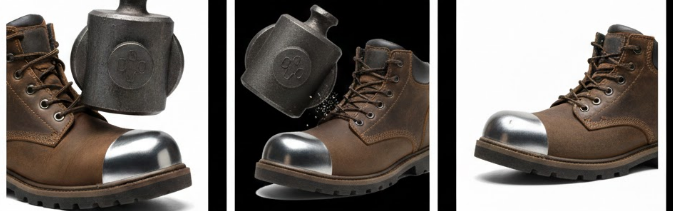
1️⃣ Steel Toe Cap
The most traditional and most “intuitively reassuring” choice.
Advantages:
- High impact resistance
- Controllable cost
Hidden problems:
- Heavy
- Conductive (thermal and electrical)
- Fatigue from prolonged wear
Suitable for:
High-risk, low-comfort environments
2️⃣ Composite Material Toe Cap
Many people are surprised the first time they wear it:
“How is it so light?”
Advantages:
- Lightweight
- Non-conductive
- Non-conductive (thermal)
Disadvantages:
- Slightly higher cost
- Requires advanced manufacturing processes
Suitable for:
Warehouse and logistics jobs requiring prolonged standing and walking
3️⃣ Aluminum Alloy Toe Cap
A compromise between steel and composite materials.
- Lighter than steel
- Stronger than composite materials
- Moderate cost
VI. When does a Toe Cap truly “fail”?
This is rarely discussed.
Toe cap problems are usually not due to poor material quality, but rather:
Ill-fitting size
- Toe box too short
- Toes constantly pressing against the inner wall of the toe cap
Cut-down structural design
- Thickness meets requirements
- But the shape is unreasonable
The usage environment is ignored
- Dampness
- Corrosion
- High temperature
The result is:
The toe cap fails when it “should be performing its function most.”
VII. Why do some people “hate” toe caps?
Frankly speaking:
It’s not that toe caps are bad, it’s that they’re worn incorrectly.
Common complaints include:
- “Toes pressing against the toe”
- “Tired after walking for a long time”
- “Too heavy”
And 90% of these problems are related to choosing the wrong one.
The toe cap itself is not a burden;
An unsuitable toe cap is.
VIII. From a business perspective, toe caps are a “very worthwhile” investment.
Let’s look at it from another angle.
A pair of proper protective shoes may cost 30% to 50% more than ordinary shoes.
But what does a toe injury mean?
- Work stoppage
- Medical expenses
- Compensation
- Personnel redeployment
- Emotional well-being and morale
The value of a toe cap is never about saving money, but about avoiding “uncontrollable costs.”
IX. Toe Caps Are Not for “Injury-Prone Individuals”
This is a crucial shift in understanding.
It’s not for newcomers,
not for “careless people,”
and not something to be worn only after an accident.
The logic of a toe cap is:
You don’t need to predict accidents; you only need to acknowledge that accidents are unpredictable.
X. In Conclusion
If you had to summarize the significance of a toe cap in one sentence, it would be:
It’s not about encouraging you to take more risks, but about protecting you when you’re not taking risks.
You might not use its true “maximum capabilities” for an entire year,
but just one use makes its existence worth every penny.
And this is precisely the most understated yet most important meaning of toe cap.
Leave a Reply