
In warehouses, forklift drivers are often the busiest and most confident group.
A grip on the steering wheel, a tap on the accelerator, pallet raising and lowering, turning and dodging—a series of actions performed with fluid grace. Many veteran drivers would even say, “After driving forklifts for so many years, what haven’t I seen?”
But it is precisely this position that has consistently seen a high accident rate.
Lifting, stacking, blind spots when reversing, mixed traffic of personnel… risks permeate almost the entire work process. And what’s even more noteworthy is that many forklift accidents are not due to “not wearing personal protective equipment,” but rather to neglecting those seemingly insignificant yet daily-used protective gear.
Today, we’ll start with a real warehouse scenario and discuss the three most easily overlooked personal protective equipment items forklift drivers.
Gloves: Used every day, yet most easily “used incorrectly”
- You might not believe it, but the most easily overlooked personal protective equipment for forklift drivers is gloves.
- Almost all forklift drivers wear gloves:
- For winter protection from freezing temperatures
- For summer slip resistance
- For protection when moving pallets and handling goods
- The problem lies here: “Wearing” doesn’t mean “wearing the right gloves.”
- Common issues include:
- Wearing ordinary cotton gloves causes the steering wheel to slip when sweaty.
- Wearing overly thick cut-resistant gloves makes control buttons unresponsive.
- Using gloves that are severely worn, with the palms no longer providing slip resistance.
- These problems may seem insignificant in daily operation, but the consequences can be very serious in emergency braking, rapid turns, or passing in narrow passages.
- What kind of gloves do forklift drivers truly need?
- A non-slip coating on the palms, not just “wear-resistant.”
- A gloves that fit the hand shape without affecting handling.
- A certain level of oil and stain resistance (you know how warehouse environments are).
- In short:
- Gloves are not “just any pair you wear,” but crucial equipment that directly affects operational safety.
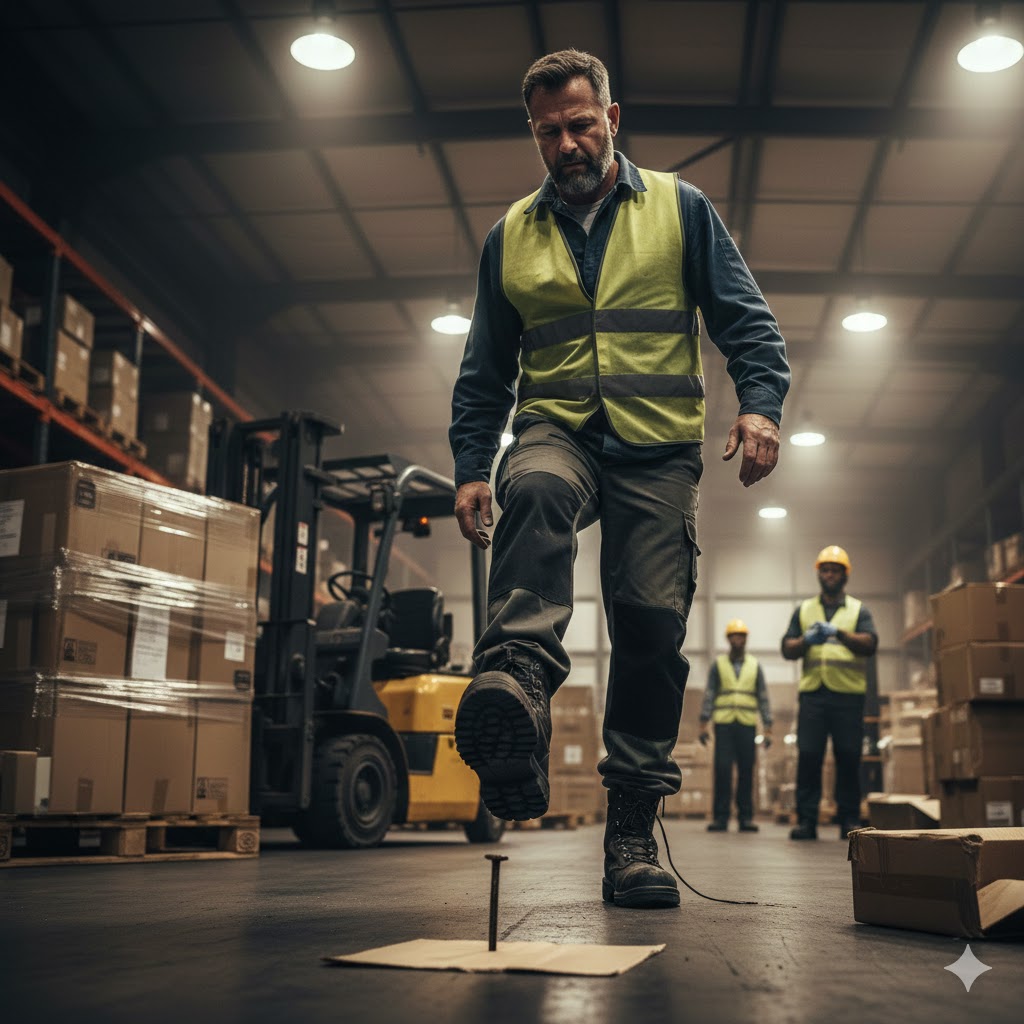
Safety Shoes: Many Wear Them, But the Wrong Type
“I always wear safety shoes.” This is the first reaction of many forklift drivers when they hear about a safety inspection.
- But if you look closely, you’ll find that many are wearing:
- Hard toe caps, but slippery soles.
- Suitable for construction sites, but not for warehouses.
- Protective against impact, but severely inadequate in terms of slip resistance.
- Warehouse forklift drivers face a unique ground environment:
- The ground may have oil or water stains.
- Frequent ups and downs of platforms and ramps.
- Large temperature differences between inside and outside the warehouse, and frequent slippery conditions.
- In this environment, slip resistance is often just as important as impact resistance.
- Real-life accident scenarios:
- A driver gets out to check goods, steps on an oily edge of the platform, and instantly slips; The driver doesn’t fall, but instinctively tries to grab the forklift, resulting in a scrape on the arm from the fork arm.
- The problem isn’t “not wearing shoes,” but rather that the shoes are unsuitable for the forklift operating environment.
- A more reasonable choice would be:
- Equal emphasis on impact resistance and slip resistance
- Shoes with good grip on smooth surfaces
- Shoes that are not too heavy to avoid fatigue during long driving periods
Reflective Protective Equipment: Not for the driver to see, but for others to see.
Many forklift drivers are resistant to reflective vests and anti-reflective strips:
- “It’s not a road in a warehouse, why would I need them?”
- But the truth is: A large proportion of forklift accidents in warehouses are because “others didn’t see you.”
- Especially in these scenarios:
- High shelves obstructing vision
- Blind spots when reversing or turning
- Passenger and vehicle lanes sharing the same space
- Night shifts or poorly lit areas
- The forklift driver may know their position clearly, but pickers and pedestrians may not see the forklift immediately.
- The purpose of reflective vests, reflective To make you “identifiable” immediately.
- It’s not an added burden, but rather, in chaotic environments, it helps you gain those crucial few seconds of reaction time. In conclusion: Truly professional safety begins with “overlooked small details.”
- In logistics and warehousing, forklift drivers are the core of efficiency and also the concentration point of risk.
- Many accidents often don’t occur due to “major problems,” but rather stem from these:
- Gloves used daily but never checked
- Safety shoes that look sturdy but lack slip resistance
- Reflective protective gear considered inconvenient but potentially life-saving
- Professional safety equipment is not just a formality, but serves specific positions and specific scenarios.
- If you are configuring safety equipment for your warehouse, consider re-examining the forklift driver role:
- Do they use it smoothly?
- Is it comfortable to wear?
- In critical moments, does it truly protect people?
Safety often lies hidden in these overlooked small details.
Leave a Reply