
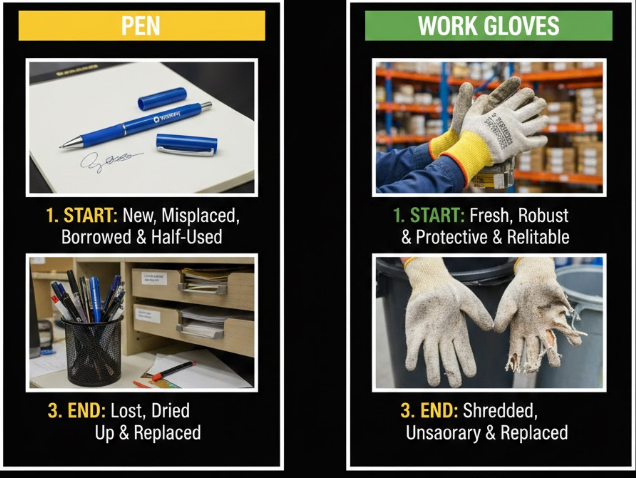
If you ask a company what gets used up the fastest, replaced most frequently, yet is least seriously discussed, the answer is often not equipment or systems, but those inconspicuous items—consumables.
A pen, a pack of paper, a pair of gloves, a roll of tape.
They are picked up, used, and consumed daily, leaving almost no trace, yet they constitute the most real, and most easily overlooked, “hidden thread” in a company’s operations.
Today, we won’t discuss macro-management or complex theories; we’ll simply follow this hidden thread to examine the true lifecycle of a company’s consumables, from “being purchased” to “complete disappearance.”
I. Their Starting Point is Often Ordinary
In most companies, consumables start from roughly the same point.
- On the purchase order, they’re listed after equipment.
- In the budget, they’re categorized as “minor items.”
- In discussions, they rarely become the focus.
“Let’s just pick one randomly.”
“They’re all consumables anyway, we’ll replace them when they’re used up.”
“This one’s cheap, let’s try it.”
Thus, a pen, a pair of gloves, are delivered to the company in bulk.
No one expects them to “create value”; everyone just hopes they won’t cause problems, won’t be too expensive, and won’t be troublesome.
But many companies overlook one point: the fate of consumables is actually half determined from the moment they are purchased.
II. Entering the Usage Stage: Fate Begins to Diverge
The true “life” of consumables doesn’t begin in the warehouse, but from the moment they are taken away.
Two Fates for a Pen
Two pens:
- Some are fixed at workstations, convenient and easy to write with, used until the ink runs out.
- Some are placed in public areas, in the meeting room today, at the front desk tomorrow, and disappearing after three days.
It’s not a difference in quality, but the usage scenario that determines their fate.
The Real Situation of a Pair of Gloves
Gloves are even more obvious.
- With clear job roles and a clear replacement frequency → Used cleanly and regularly.
- Without boundaries, anyone can take them → Half-used and thrown away, wrong size taken, serious waste.
Many companies attribute “rapid consumption” to employees, but the real problem is often:
Consumables are not given a clear “role” when they are put into use.
III. The Most Easily Overlooked Stage: The Chaotic Period
Almost all businesses’ consumables go through a stage—the chaotic period.
This stage has several typical characteristics:
- Usage is extremely rapid, but the reason is unclear.
- There’s always a feeling of “not enough,” yet the warehouse is overflowing.
- Purchasing frequency increases, but there’s no improvement in cost-effectiveness.
Thus, common conversations arise:
- “Why are our pens running out again?”
- “Are the gloves being used for something else?”
- “Should we buy more at once?”
But few realize:
This is the most critical and easily out-of-control stage in the consumable’s lifecycle.
IV. The Most Common Misjudgment by Businesses: Treating “Consumption” as “Waste”
At this stage, many companies make an instinctive reaction: tightening controls.
- Limited issuance
- Registration
- Quantity reduction
- Budget constraints
This seems reasonable, but the results are often counterproductive.
- The complex requisition process leads employees to “take extra for unforeseen circumstances.”
- If they can’t get suitable items, they make do with whatever they can find, mixing and matching.
- While it seems like they’re saving money on the surface, actual efficiency decreases.
The problem isn’t that consumables are “used in large quantities,” but rather that:
The company hasn’t distinguished between “normal consumption” and genuine waste.
V. What does a truly healthy consumable lifecycle look like?
If you carefully observe companies with relatively stable consumable management, you’ll find several commonalities.
1️⃣ They know “who is using it.”
Not every item needs to be registered, but they clearly understand:
- Which positions have high-frequency consumption?
- Which areas have public consumption?
- Which items must be dedicated to specific purposes?
Consumables aren’t “shared by everyone,” but rather rationally allocated and used.
2️⃣ They accept “being consumed.”
Healthy companies don’t pursue “the longer the better,” but rather:
- Use it smoothly
- Use it with peace of mind
- Replace it when it’s time to use it
A pair of gloves, a pen—they should have a dignified end.
3️⃣ They don’t frequently change their “consumption logic”
Switching brands today to save money,
switching back tomorrow due to complaints,
switching again the day after due to inventory pressure.
This kind of repetition is often more wasteful than “using a little more”.
VI. Consumables often leave signals before disappearing
Interestingly, consumables usually give warning signs before “abnormally disappearing”:
- Employees start complaining that they “don’t work well”
- Alternative uses appear on-site (e.g., using tissues as rags)
- Severe mixing of similar products
If these signals are ignored, companies often only see the result:
“Why do we need to restock again?”
VII. From a pen to a pair of gloves, it’s essentially the same problem
Whether it’s office supplies or work safety supplies, their lifecycles are essentially the same:
Ignored → Excessively consumed → Misunderstood → Controlled → Consumed Again
What truly breaks this cycle isn’t cheaper products or stricter systems, but rather:
- An understanding of usage scenarios
- Respect for real needs
- A correct understanding of “consumption” itself
VIII. Consumables, in fact, best reflect a company’s true state
When you visit a company, you don’t need to look at the systems or ask about policies; just observe:
- Are office supplies readily available but not cluttered?
- Are work safety supplies appropriate, clean, and orderly?
- Are consumables “just right”?
This will likely allow you to judge whether the company:
- Respects its employees
- Manages details
- Is it a long-term thinker?
Because companies that are truly valued don’t overlook these “small things.”
Conclusion: Consumption is not a bad thing
The significance of consumables is never “saving until the last minute,” but rather:
- Appearing when they should appear
- Disappearing when they should disappear
- Not creating trouble or anxiety
From a pen to a pair of gloves,
they complete, in fact, a company’s most daily and authentic cycle.
If you start to take these “things that are used up and then gone” seriously, it means that your company has begun to move towards a more mature and stable state.
Leave a Reply