
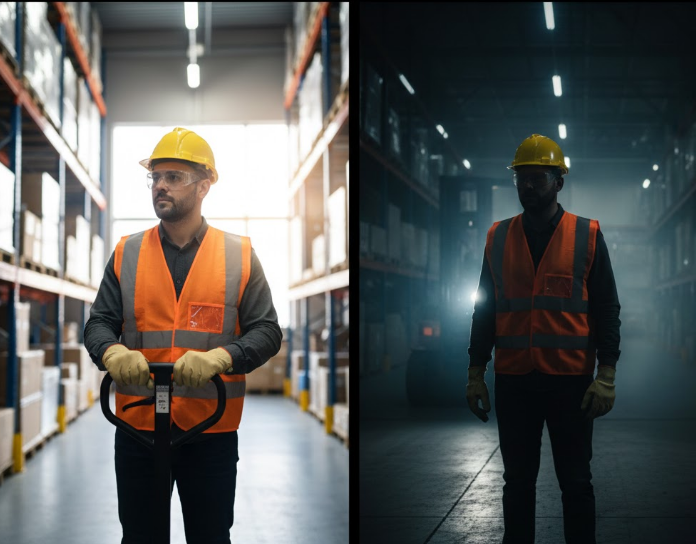
Many companies assume that the same set of safety equipment (PPE) standards can be used for both day and night shifts when configuring PPE.
However, this assumption often doesn’t hold true in real-world warehousing, logistics, and production environments.
The same safety shoes, gloves, and protective clothing may work fine during day shifts, but frequently expose hidden dangers during night shifts, even directly impacting the accident rate.
The problem isn’t “inadequate PPE,” but rather that day and night shifts are fundamentally different working environments.
What are the core differences in PPE usage between day and night shifts?
From a workflow perspective, day and night shifts may seem highly similar, but the differences are significant in the following aspects:
- Different physiological rhythms (night shifts are more prone to fatigue and slower reaction times)
- Different lighting conditions
- Different management and support resources
- Different employee “tolerance” for PPE
This means that the same set of PPE faces a “magnified test” during night shifts.
Why do PPEs that are “qualified” for day shifts cause more problems during night shifts?
Many companies have reported similar phenomena:
- Day shifts see almost no complaints about personal protective equipment (PPE).
- Night shifts, however, frequently report issues such as “unusable,” “uncomfortable,” and “impact on operations.”
The reasons typically fall into three categories:
1. Night shifts rely more on the PPE itself than on environmental compensation.
Day shifts have better lighting and more personnel, allowing for the timely detection of many risks.
Night shifts rely more on “hard indicators” such as slip resistance, protection, and tactile feedback.
2. Fatigue amplifies the shortcomings of PPE.
Slightly hard soles, slightly thick gloves, or slightly fogged goggles,
are tolerable during day shifts, but discomfort quickly accumulates during night shifts.
3. Night shift employees are more likely to “vote with their feet.”
Unusable PPE is more likely to be replaced privately or simply abandoned during night shifts.
Why is there such a significant difference in the performance of the same pair of safety shoes between day and night shifts?
Safety shoes are one of the PPEs with the most obvious differences between day and night shifts.
In night shift environments, safety shoes, besides the basic requirements of:
- impact resistance
- puncture resistance
must also simultaneously meet the following criteria:
- better anti-slip performance
- better cushioning and rebound during extended walking periods
- foot stability under fatigue conditions
If safety shoes are selected solely based on “protection level” while ignoring the actual usage scenarios of night shifts, they may appear adequate for day shifts but are more likely to cause slips, sprains, and chronic fatigue at night.
Work gloves: Why are they more likely to become uncomfortable to wear at night?
Gloves become significantly more noticeable at night.
In night shift environments:
- Visual judgment declines
- Tactile feedback becomes the primary feedback
At this time, the following problems are rapidly amplified:
- Gloves that are too thick affect grip accuracy
- Insufficient anti-slip performance makes them prone to slipping off
- Poor breathability leads to discomfort from prolonged wear at night
Many night shift workers modify their gloves privately, not because they disregard safety, but because standard configurations do not meet the needs of night shifts.
Protective Clothing and Reflective Design: Night Shift Safety Isn’t About “Having It,” But “Having It Enough”
Many companies provide reflective vests and protective clothing for night shift employees, but insufficient visibility still occurs.
- Common reasons include:
- Small reflective strip area
- Easily obstructed location
Incompatible with actual night shift work posture
In night shift scenarios,
“Being visible” is itself an important form of safety protection.
Is it necessary to provide a separate set of personal protective equipment (PPE) for night shifts?
The answer isn’t necessarily “buy another set,” but rather “add another perspective for the night shift.”
When choosing the same set of PPE, focus on:
- Suitable for extended wear
- Safe in low-light conditions
- Easy to use even when fatigued
The same PPE can also have designs that are “night shift friendly.”
In conclusion:
Truly qualified personal protective equipment (PPE) can withstand the test of night shifts.
PPE is not simply something that “works well enough for day shifts.”
True safety protection means being able to be used continuously in the fatigue, high-risk, and low-tolerance environment of night shifts.
Successful day shifts and successful night shifts are the keys to choosing the right PPE.
FAQ:
Q1: Do I need to use different PPE for day shifts and night shifts?
Not necessarily. The key is whether the night shift usage scenario has been considered, not whether the configuration is “completely different.”
Q2: Which types of PPE are most prone to problems during night shifts?
Usually, safety shoes, work gloves, and protective clothing (reflective and visibility-sensitive).
Q3: How do I determine if a piece of PPE is suitable for a night shift?
The most direct method is to listen to the actual feedback from night shift employees, rather than just looking at the specifications.
Q4: Does configuring PPE for night shifts always increase costs?
Not necessarily. Appropriately selecting designs and performance focuses can often reduce accidents and replacement costs.
Leave a Reply