
Why are we willing to be “windbreakers” in the rainy night?
Every cycling enthusiast knows that the sense of freedom this sport brings is irreplaceable. Whether traversing the fog at dawn or weaving through the darkness after get off work, the sounds of the wind, the wheels, and the heartbeat create the most beautiful symphony.
However, this sense of freedom also comes with a huge pain point: when we become “windbreakers” in the night, we often become the most dangerous “invisible ghosts.”
Pain Point 1: Visibility Anxiety.
At night, in heavy rain, or in smog, do you worry about being overlooked by other vehicles? In the darkness, dark cycling gear makes you blend into your surroundings, and every turn and lane change is accompanied by a heart-pounding feeling.
Pain Point 2: The Pain of Being Soaked.
A non-waterproof garment will leave you completely soaked in a downpour, causing a sharp drop in body temperature, and the sticky feeling will completely destroy the enjoyment of cycling. A non-breathable raincoat will make you feel like you’re in a sauna inside, with sweat causing more discomfort than rain.
You crave a piece of gear that perfectly balances absolute waterproofing, superior breathability, and maximum visibility. This is the “iron triangle balance” of a waterproof reflective cycling jacket.
An excellent waterproof reflective jacket is far more than just a “plastic raincoat + a few reflective strips”; it’s a perfect combination of materials science, safety standards, and ergonomics.
First Dimension: Core Safety Guarantee – Reflective Visibility and International Certification.
The reflective performance of cycling apparel is the first line of defense for rider safety. It needs to meet industrial-grade standards to function effectively in extreme visibility conditions.
1. The “Reflectivity” of Reflective Materials: Being Seen is Key
Reflective materials work by precisely reflecting light (like bicycle headlights) back to the source, rather than scattering it. This efficient reflection instantly “illuminates” your silhouette in the dark.
● Professional Standards: When choosing, pay attention to whether the reflective material is certified to international standards, such as EN ISO 20471 or ANSI/ISEA. 107. For high-risk activities like cycling, we strongly recommend choosing high-grade reflective materials. Even with small areas of clothing, this ensures the brightness, width, and placement of reflective strips meet maximum visibility requirements.
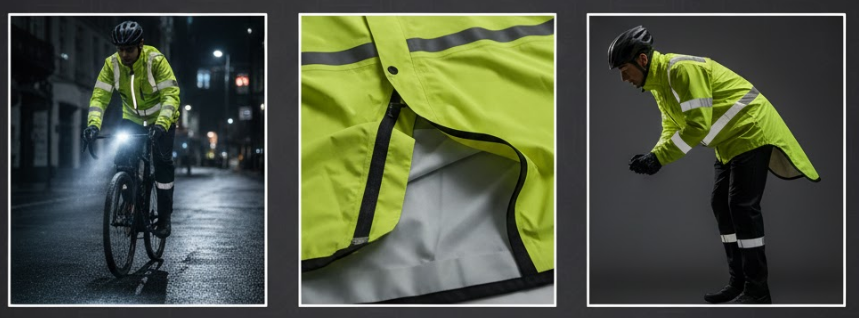
● 360° Visibility: Excellent cycling reflective clothing must be “360° visible.” This means reflective strips must extend beyond the chest and back to the sleeves, wrists, and sides. Because cycling involves varied body postures, reflective strips on the sides and arms are crucial for drivers to judge your intentions (e.g., hand signals for turning).
Resonance Point: A sense of security while cycling often comes from knowing you are not being ignored. A jacket fully covered in reflective strips acts like a moving spotlight, giving you greater confidence in controlling the road.
2. Fluorescent Colors: A “High-Profile Declaration” for Day and Dusk
Many cycling accidents occur during low-light transition periods such as dusk or dawn. At these times, reflective strips are not yet fully effective, and visibility relies entirely on fluorescent colors (bright yellow-green, bright orange).
● Outdoor Sports and Industrial Safety: Fluorescent colors convert invisible ultraviolet light into visible light, making the colors appear exceptionally bright on cloudy days or at dusk. Nature Tour-recommended cycling apparel uses highly saturated fluorescent fabrics, ensuring you’re the most visible presence on the road from the moment you leave home.
Second Dimension: Functional Challenges – The Paradox of Waterproofing, Windproofing, and Breathability.
Waterproofing and breathability are technically difficult to reconcile. A highly waterproof raincoat is often not breathable; conversely, breathable clothing is rarely completely waterproof. Cycling apparel must perfectly resolve this paradox.
1. Waterproofing Performance: More Than Just “Water Repellent”
A qualified waterproof cycling garment must meet industrial-grade waterproofing standards, not just the cheap “water-repellent” (DWR) of a cheap jacket.
● Water Column Pressure Rating: Professional waterproofing performance uses **Water Column Pressure (Water Column)** Water resistance is measured by its rating. For long, moderate-to-high intensity cycling, we recommend choosing a waterproof rating of 10,000mm (10K)** or higher. This ensures that you can ride for more than an hour in moderate to heavy rain without water pressure penetrating the fabric.
● Details Matter: When purchasing online, be sure to confirm that all seams are “seam taping”. Check if the zippers are waterproof zippers. Even the best fabric is useless if water gets into the seams and zippers.
2. Breathability: Solving the Pain of “Inner Rain”
Cycling is a high-heart-rate aerobic exercise, raising body temperature and causing sweat to evaporate. If water vapor is trapped inside clothing, it will quickly become soaked, feeling even more uncomfortable than being soaked in rain.
● Breathability Rating (MVP/Grams): Professional cycling apparel will indicate its Moisture Vapor Permeability (MVP). We recommend choosing a breathability rating of 5,000 g/m²/24h or higher.
● Ventilation Design: Excellent cycling apparel incorporates “pit zippers” and back vents. These designs allow for active ventilation and heat dissipation during exercise without sacrificing waterproofness.
Key to Comfort: True comfort is riding in the rain without feeling the cold, damp outside or the stuffy heat inside. This dry riding experience is the key to evaluating a waterproof garment.
Third Dimension: Ergonomics – Details Designed for Cycling
The cut and function of cycling apparel must conform to the riding posture (bending forward). Ordinary raincoats will only hinder your movements.
1. Cut and Fit: Cycling apparel typically uses an “Athletic Fit” to reduce wind resistance. However, waterproof reflective clothing is usually worn over cycling apparel, so the cut needs to fit the body to reduce wind blasts while allowing enough room for layering.
2. Cycling-Specific Details:
● Drop-Tail Extension: This is a signature design feature of cycling apparel. The back hem is significantly longer than the front, perfectly covering the waist exposed when bending over while cycling, preventing rain and mud from splashing in.
● High collar and cuffs: The high collar and adjustable cuffs (usually with Velcro) effectively prevent wind and rain from entering through the gaps.
● Pocket placement: Pockets on cycling apparel should be located high on the chest or sides for easy one-handed access while riding.
Fourth Dimension: Trust and Value – Nature Tour’s Commitment
Leveraging our expertise in industrial safety products, Nature Tour understands that safety standards are non-negotiable. We bring stringent industrial-grade standards to cycling gear:
1. Eliminating the Safety Premium: Many sports brands attach high brand premiums to cycling apparel. Nature Tour optimizes its supply chain by working directly with internationally certified factories, providing waterproof and reflective clothing that meets EN ISO 20471 standards, allowing you to obtain professional safety at a more reasonable price.
2. Dual Protection of Comfort and Safety: Our products guarantee Class 2/3 safety. High visibility combined with carefully selected high-breathability fabric ensures you stay dry and comfortable during long rides.
3. Professional Consultation Service: Our customer service team is knowledgeable not only about safety and workwear but also about cycling. If you’re unsure whether to choose a 5K or 10K waterproof rating, or a slim or relaxed fit, we can provide professional advice to ensure you get the perfect product for your riding environment.
Conclusion: Balancing Safety, Comfort, and Cost for the Perfect Ride
Choosing a waterproof, reflective cycling jersey adds a layer of security to your love of freedom. This isn’t just optional gear; it’s the core confidence that allows you to be a “windbreaker” in the rain.
When purchasing, please pay attention to: visibility certification level, waterproof seam sealing and breathable design, and ergonomic details that conform to your riding posture.
FAQ: 3-5 related questions and answers
Q1: Will the reflective strips on a waterproof reflective cycling jersey fall off or become ineffective after prolonged use? A1: Low-quality reflective strips can indeed crack or fall off after frequent washing and folding. Professional cycling jerseys (such as those recommended by Nature Tour) typically use highly durable reflective materials that can withstand more than 50 gentle wash cycles. To extend its lifespan, please follow the instructions, do not use fabric softener or bleach, and avoid high-temperature drying and ironing, as this effectively protects the reflective microprism structure.
Q2: If a garment has a high waterproof rating (e.g., 15K), is its breathability necessarily poor? A2: Not necessarily. It’s a technical challenge, but modern materials science has largely solved it. Higher-priced fabrics (such as certain high-performance membrane technologies) can provide excellent breathability while maintaining high water resistance. When choosing, don’t just look at the water resistance rating (mm), but also the breathability rating (g/m²/24h). For cycling, we recommend products with both high water resistance and high breathability ratings.
Q3: Should I choose a reflective jacket or a reflective vest? A3:
● Reflective Vest: Suitable for summer, short rides, or as an extra layer of safety over an existing waterproof jacket. It provides necessary visibility but lacks waterproof and windproof features.
● Reflective Jacket: Highly recommended for inclement weather, rain, or winter riding. It combines waterproof, windproof, warmth, and high visibility, offering more comprehensive functionality.
Q4: Why are the sleeves and back of cycling jerseys made longer? A4: This is typical ergonomic design, entirely to accommodate the riding posture:
● Long sleeves: Ensures that your wrists are not exposed when you extend your grip forward.
● Drop-Tail: Ensures your waist and hips are fully covered when you bend over, preventing rain and mud splashes from wetting your body.
Q5: Does the color of reflective clothing affect visibility? A5: Yes. During the day and at dusk, **fluorescent colors (bright yellow-green, bright orange)** have significantly higher visibility than ordinary colors, a scientifically proven finding. At night, visibility depends primarily on the quality of the reflective strips, but fluorescent base colors still provide better visibility in low light. Therefore, for maximum safety, choose reflective clothing with a fluorescent base.
Leave a Reply