
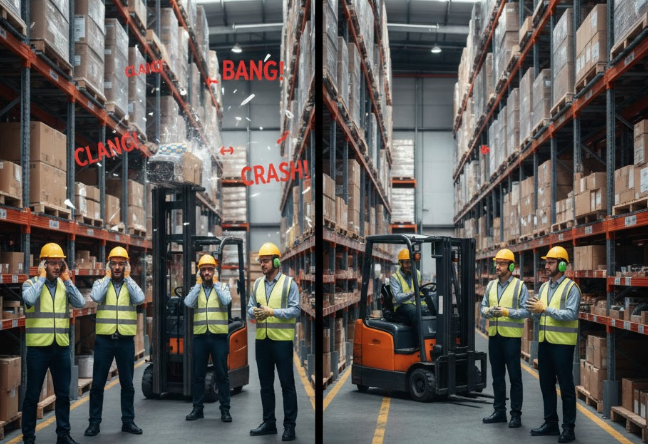
If you’ve visited enough warehouses, you’ll notice something interesting: Some warehouses are noisy, but not from the machines; some warehouses are messy, but not from the goods.
What you might hear is:
- “This glove is torn again!”
- “Why are the soles of my shoes so slippery?”
- “These wristbands are impossible to use!”
- “Do you have any new ones? This one won’t work!”
But in another type of warehouse, the noise is significantly less.
Forklifts are moving, goods are moving, but people rarely complain, rarely stop to “torture themselves.”
What’s the difference?
Many people’s first reaction is: good management, smooth processes.
But once you’re on the front lines, you’ll find there’s another often underestimated reason:
Whether the protective equipment is chosen correctly directly determines how “noisy” the warehouse is.
This “quiet” doesn’t mean there’s no sound, but rather no unnecessary sound.
I. Much of the “noise” in a warehouse isn’t actually generated by equipment.
A warehouse isn’t a library.
Forklift noise, pallet rubbing, packaging noise—these are all normal.
What truly makes the work site “noisy” are often the following sounds:
- Employees constantly asking others to exchange supplies
- Team leaders being repeatedly called in for coordination
- Safety officers being forced to handle minor issues on the spot
- Emotional complaints arising from inconvenience
These sounds aren’t loud, but they’re frequent, like background noise, present all day long.
And behind them, many point to the same problem:
The personal protective equipment (PPE) is “unsuitable,” but not serious enough to require immediate replacement.
II. Unsuitable PPE is most likely to create “hidden chaos”
Wrong gloves slow down movement
Many warehouses experience this phenomenon: Glove inventory seems plentiful, but employees still don’t use them frequently.
The reason is usually not “not issued,” but rather:
- Too thick, making picking difficult
- Too slippery, making it hard to grip the film
- Too stuffy, causing sweating after wearing for a while
- Incorrect size, hindering finger dexterity
As a result, the following occur on-site:
Some people wear them, some take them off; some secretly switch brands; some simply go bare-handed.
Slow movements disrupt the rhythm; disrupted rhythm naturally leads to noise on-site.
Uncomfortable work shoes lead to complaints all day.
Work shoes are among the most “emotional” items in the warehouse.
You rarely hear employees complaining all day about their helmets,
but a pair of unsuitable shoes can lead to complaints from morning till night.
- Toe pinching
- Sole too hard
- Not breathable
- Inadequate slip resistance
- Feeling heavy like lead
The result is:
- Slow walking
- Frequent sitting
- Low mood
- More impatience with on-site instructions
When the body is constantly uncomfortable, even the best workflow will be slowed down.
Overly noticeable protective gear actually hinders efficiency.
Wristbands, knee pads, and back supports are meant to protect people.
But choosing the wrong size can turn them into a burden.
Common problems include:
- Too tight, affecting blood circulation
- Too loose, ineffective
- Design unsuitable for high-frequency movements
- Stuffy in summer, stiff in winter
As a result, you’ll see: Wearing it for a short time, then taking it off, then being asked to put it back on, then taking it off again…
Repeated pulling and tugging naturally creates a tense atmosphere.
Three, “Quiet warehouses” often share these characteristics:
If you compare multiple warehouses, you’ll find that those with relatively quiet environments aren’t necessarily those with less usage of supplies, but rather:
✔ Low “presence” of the protective equipment
It doesn’t steal the spotlight, doesn’t get in the way, and isn’t frequently discussed.
✔ Most people are willing to wear it voluntarily
Not because of regulations, but because they feel uncomfortable not wearing it.
✔ Stable replacement frequency
No batches today, no batches tomorrow, no last-minute requests every few days.
✔ Complaints focus on “running out,” not “not working well.”
This is a very important distinction.
Four, Choosing the right protective equipment is essentially about “reducing interference”
Many people understand the value of protective equipment as: protection, compliance, and safety. However, in a real warehouse, it has another underestimated role:
Reducing unnecessary interference.
- It doesn’t disrupt the work rhythm.
- It doesn’t increase management costs.
- It doesn’t create emotional fluctuations.
- It doesn’t trigger ad-hoc coordination.
When these “disruption points” are reduced, the site naturally becomes quiet.
This quietness isn’t achieved through shouting or pressure from regulations,
but rather through the supplies themselves being “just right.”
V. Why are many warehouses constantly “noisy,” yet the cause remains elusive?
Because the problem is often not about “major issues.”
- It’s not a safety accident.
- It’s not a serious violation.
- It’s not an obvious quality problem.
It’s a pile of countless “makeshift” options.
Each item individually isn’t fatal, but combined, they make the site:
- Easily frustrating
- Easily chaotic
- Easily prone to problems
And personal protective equipment (PPE) is precisely the layer most easily overlooked, yet one that is handled daily.
VI. A truly mature warehouse treats personal protective equipment (PPE) as “tools,” not “consumables.”
A mature warehouse rarely asks:
“Is this cheap?”
They ask more often:
- Is it suitable for this job?
- Will it affect movement?
- Will it be tiring at the end of the day?
- Will employees be willing to wear it?
Because they know: Choosing the right PPE directly reduces the difficulty of on-site management.
In conclusion:
A truly “quiet” warehouse is not one where no one talks, but one where no one is forced to be distracted.
When employees don’t have to endure discomfort while working,
when supervisors don’t have to repeatedly deal with “small but annoying” problems,
when safety officers don’t have to rely on reminders to maintain wearing rates,
you’ll find:
- A more stable on-site rhythm
- Smoother communication
- Peace of mind
- Fewer problems
And all of this sometimes starts with—choosing the right pair of gloves, a pair of shoes, or a truly suitable piece of PPE.
Leave a Reply