
Why is the logic of “replace only when it breaks” inherently flawed?
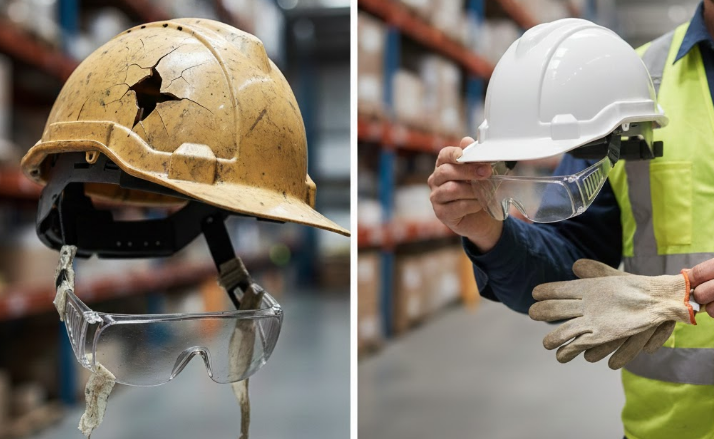
In many companies’ management of personal protective equipment (PPE), the sole criterion for replacement is whether it’s broken.
Helmets are replaced only when they’re cracked, gloves only when they’re torn, and safety shoes only when the soles come unglued.
This approach may seem cost-effective, but in actual production and work environments, it’s the management method most likely to create safety hazards.
Because for most PPE, true failure often occurs when it “doesn’t appear broken yet.”
I. “Ineffective” PPE ≠ “Damaged”: Many Risks Are Invisible to the Naked Eye
1. The protective performance of PPE decreases over time and with use.
A common misconception is:
Intact appearance = Effective protection
However, the following situations are very common on-site:
- The safety helmet shell is intact, but the internal cushioning layer has aged.
- Cut-resistant gloves are not damaged, but their cut resistance has significantly decreased.
- Dust masks are still wearable, but their filtration efficiency is insufficient.
- Safety shoes have soles, but their anti-slip and puncture resistance has diminished.
The core value of PPE is its protective performance, not its service life.
II. Why is “replacing only when it breaks” the most costly management approach?
2.1 The Hidden Costs of Safety Accidents That Are Often Overlooked
The costs of an accident often far exceed the cost of the PPE itself:
- Medical and compensation expenses
- Work stoppage, investigation, and rectification costs
- Management responsibility and compliance risks
- Damaged customer and brand trust
- And these costs never appear in the procurement comparison list.
2.2 Decreased User Experience Leads to “Unused Supplies”
When personal protective equipment (PPE) enters the “almost broken” stage, common consequences include:
- Inflexible operation, decreased efficiency
- Uncomfortable to wear, employee resistance
- Unauthorized replacement, borrowing, or even non-wearing
While seemingly saving on procurement costs,
it actually erodes efficiency, safety, and management order.
III. Five Key Signals for Determining Whether PPE Should Be Replaced
Instead of waiting until it’s “broken,” pay attention to the following more reliable criteria.
3.1 Has the Protective Performance Decreased?
This is the primary criterion for determining whether PPE should be replaced.
- Has it exceeded the recommended usage period?
- Has it undergone high-intensity or abnormal use?
- Is it in the performance degradation stage?
Performance failure is always more dangerous than cosmetic damage.
3.2 Has the Wearing Comfort Significantly Decreased?
Changes in comfort often indicate:
- Material aging
- Structural deformation
- Decreased fit
And “uncomfortable” PPE will almost certainly reduce its wearing rate.
3.3 Are there any abnormalities in usage frequency?
Key areas to focus on:
- Abnormal differences in consumption for the same job position
- Long-term unused inventory of certain types of personal protective equipment (PPE)
- Sudden drop in usage
This is usually not due to cost-saving measures, but rather avoidance of use on-site.
3.4 Have job risks or the working environment changed?
Existing PPE should be reassessed when the following situations occur:
- Process adjustments
- Increased work intensity or frequency
- New equipment or materials introduced
- Changes in ambient temperature, dust, or humidity
When job positions change, PPE configurations must also change.
3.5 Have employees started “self-replacing” PPE?
Employees privately:
- Purchasing gloves
- Borrowing supplies from other positions
- Replacing with non-standard models
This is often not a violation, but a very clear signal:
The existing PPE is no longer suitable for the actual needs on site.
IV. Truly professional PPE management focuses on the “replacement mechanism”
4.1 What are the differences between scrapping standards and replacement mechanisms?
Disposal Standards: What to do when it breaks?
Replacement Mechanism: When to proactively replace?
Mature companies focus more on the latter.
4.2 A reasonable replacement mechanism for personal protective equipment (PPE) typically includes:
- Recommended usage cycles for different PPEs
- Differentiated replacement frequencies for different positions
- Dynamic adjustments based on risk levels
- Real feedback from frontline employees
This doesn’t increase complexity, but rather reduces long-term risks.
V. Why does “timely replacement” actually save money?
When PPEs are:
- More suitable
- Easier to use
- More aligned with job requirements
Employee compliance will actually increase,
and violations, waste, and friction will decrease.
Good PPE management is essentially about reducing the cost of conflict.
Conclusion: PPEs should not be “used until they break,” but “replaced before they become ineffective.”
In short:
The value of PPEs lies not in using them to their limit,
but in their effectiveness while they are still functional.
Waiting until they break may seem economical,
but it actually trades safety, efficiency, and risk for savings.
FAQ:
Frequently Asked Questions about Personal Protective Equipment (PPE) Replacement
Q1: Must PPE only be replaced when it’s broken?
No. Most PPEs are no longer safe when their performance deteriorates and should be replaced before they become unusable.
Q2: How to determine if PPEs are unusable?
A comprehensive assessment can be made based on factors such as usage period, protective performance, comfort, frequency of use, and changes in job risk.
Q3: Is replacing PPE too frequently wasteful?
Replacing PPEs appropriately is not wasteful; on the contrary, it reduces accidents, violations, and efficiency losses, making it a more cost-effective practice in the long run.
Q4: Is employee reluctance to wear PPE related to replacement?
Highly related. Inappropriate or worn-out PPEs are one of the main reasons why employees do not wear them.
Q5: How should companies establish a PPE replacement mechanism?
A dynamic adjustment mechanism should be developed based on job risk level, usage intensity, product characteristics, and employee feedback.
Leave a Reply