
In the logistics industry, “safety” is never an abstract concept.
Daily loading, unloading, handling, sorting, and transportation involve repetitive high-risk actions.
Many companies, despite having adequate personal protective equipment (PPE), still experience frequent accidents. The reason is often not “whether they have it,” but rather “whether they are using it correctly.”
This article will systematically outline the following points based on real-world logistics operations:
What are the commonly used PPEs in the logistics industry?
How should different positions be equipped with them?
Which are the most easily overlooked yet most critical protective measures?
Why must the logistics industry prioritize the provision of PPEs?
The risks in the logistics industry have a distinct characteristic: high frequency, rapid action, and low tolerance for error.
Common risks include:
- Heavy object handling → Injuries from falling objects or crushing objects
- High-frequency walking → Slips and sprains
- Unpacking operations → Cuts and bullet wounds
- Forklift traffic → Collisions and blind spot accidents
These risks are difficult to mitigate with mere reminders; appropriate personal protective equipment (PPE) is essential.
The 6 most commonly used categories of PPE in the logistics industry
Hand protective equipment (highest frequency of use in the logistics industry)
In logistics operations, hands are involved in almost all work, making them the fastest-wearing and most frequently injured part of the body.
Common Hand Protective Equipment:
- Cut-resistant gloves (for unpacking and removing cable ties)
- Abrasion-resistant gloves (for loading, unloading, and palletizing)
- Non-slip coated gloves (for wet and slippery environments)
- Nitrile/latex gloves (for packaging and light handling)
Common Problems:
- Gloves are too thick, affecting operation.
- Insufficient cut resistance.
- Inappropriate size, employees are unwilling to wear them.
Gloves are not just “useful”; they must be matched to the intensity of the job and the delicacy of the operation.
Foot Protection Equipment (Highest Risk of Accidents)
In logistics accidents, foot injuries often have the most serious consequences:
- Pallet Drop
- Goods Slipping
- Misstepping on the platform
Common Foot Protection Equipment:
- Anti-Impact Safety Shoes (Steel Toe Cover / Composite Toe Cover)
- Punch-Resistant Safety Shoes (Kevlar Midsole)
- Anti-Slip Safety Shoes (Wet Ground, Cold Storage)
- Lightweight Safety Shoes (For Prolonged Standing Positions)
Safety shoes are not “the heavier the better,” but rather should be suitable for the job and something employees are willing to wear.
Head Protection Equipment (Essential for High-Level Work)
In high-rack areas and areas with frequent forklift traffic,
danger often comes from unexpected collisions.
Common Head Protection Equipment:
- ABS Safety Helmet
- Lightweight Safety Helmet (Indoor Warehouse)
The most common problem in reality is:
Experienced employees don’t wear them, while new employees are required to.
Lightweight design is precisely to improve actual wearability.
Eye and Face Protection Products
Unpacking wooden crates, cutting cable ties, and snapping plastic straps can all cause eye injuries.
Common Products:
- Impact-resistant goggles
- Anti-fog goggles (cold storage environment)
- Face shields (cutting and packing workstations)
Eye protection accidents are rare, but when they occur, the impact is significant.
Body and High-Visibility Protection Products
In situations with many forklifts, intersecting aisles, and night shifts,
being seen is itself a safety guarantee.
Common Products:
- Reflective Vest
- High-Visibility Workwear
- Cold Chain Winter Clothing
Hearing and Respiratory Protective Equipment (Key Point for Automated Warehouses)
Common Problems in Automated Sorting Centers:
- Concentrated Noise
- Increased Dust
Common Products:
- Earplugs/Earm Covers
- Dust Masks
How Should Personal Protective Equipment (PPE) Be Configured for Different Logistics Positions?
Position | Recommended PPE
- Loading/Unloading Worker | Anti-smashing Safety Shoes, Cut-resistant Gloves, Safety Helmet
- Picking Staff | Non-slip Gloves, Lightweight Safety Shoes
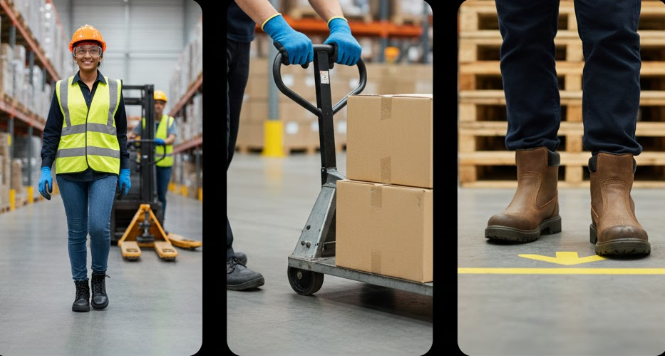
- Forklift Driver | Safety Shoes, Reflective Vest
- Packaging Staff | Cut-resistant Gloves, Goggles
- Cold Storage Operations | Winter Clothing, Non-slip Safety Shoes
Different positions, different risks; PPE should not be applied uniformly.
Why do accidents still occur even though logistics companies have provided PPE?
Common reasons include:
- Focusing solely on specifications, ignoring usage scenarios
- Uniform distribution, neglecting job differences
- Poor comfort, low wearing rate
- Abnormal wear and tear, yet no one reviews the results
The truly effective logic for PPE configuration is:
Analyze job risks first, then select protective equipment that employees are willing to use long-term.
FAQ:
Q1: What personal protective equipment (PPE) is mandatory in the logistics industry?
A: Typically includes gloves, safety shoes, safety helmets, and reflective vests. Specific requirements depend on the job’s risk profile.
Q2: Are safety shoes mandatory in logistics warehouses?
A: For positions involving loading, unloading, handling, and palletizing, protective safety shoes are strongly recommended.
Q3: Why are employees reluctant to wear PPE?
A: The main reasons are discomfort, inconvenience in operation, and incompatibility with job requirements.
Q4: Is a higher level of PPE always better?
A: No. The optimal solution is to choose the protection level appropriate for the job.
Leave a Reply