
Is hand-stretch wrap really better than machine-stretch wrap?
If you’ve ever been to a warehouse, you’ve probably seen these two scenes:
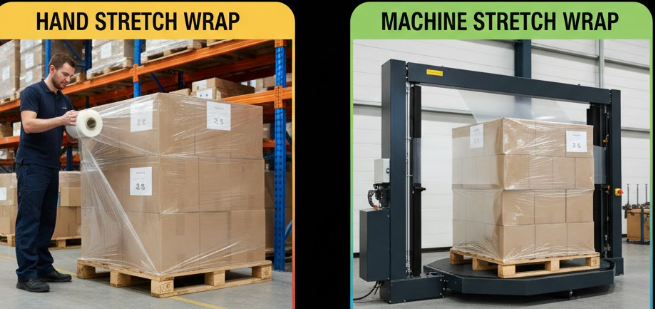
- A person walks around a pallet, holding a roll of stretch wrap, like they’re “wrapping dumplings” for the goods.
- A stretch wrapping machine slowly rotates, the pallet stands steadily in the center, and the wrap is automatically wrapped around it, circle by circle.
So the question arises: Which is better, hand-stretch wrap or machine-stretch wrap?
The answer is actually quite simple, but 90% of warehouses make the wrong choice not because they don’t understand the product, but because they haven’t considered the “use case.”
This article will explain this question thoroughly.
I. Conclusion: There is no “better,” only “more suitable.”
If you want a single answer right now, it’s this:
There is no absolute superiority or inferiority between hand-stretch wrap and machine-stretch wrap; it’s about whether it suits your warehouse.
But if you are:
- Warehouse Manager
- Purchasing
- Operations or Logistics Manager
Then you must continue reading, because the real cost differences often lie in areas you haven’t considered.
II. What is Hand-Stretch Wrap? Why is it so “common”?
1️⃣ How does hand-stretch wrap work?
It’s very simple:
- Manual stretching
- A person walks around the pallet
- The tightness is determined by “feel”
Its biggest feature can be summed up in one word: flexibility.
2️⃣ Why do almost all warehouses use it initially?
The reason is very practical:
- No equipment investment required
- Buy and use immediately
- New warehouses and temporary projects can be started immediately
For many small and medium-sized warehouses, hand-stretch wrap is an “entry-level choice”.
3️⃣ The real advantages of hand-stretch wrap (not advertising rhetoric)
- ✅ Suitable for small-batch shipments
- ✅ Suitable for irregular goods
- ✅ Suitable for temporary, non-standard pallets
- ✅ Does not rely on electricity or equipment
In short:
As long as there are people, they can work.
III. The problems with hand-wrapped stretch film are often severely underestimated.
Many warehouses say:
“We’ve always hand-wrapped it, and there haven’t been any problems.”
But have you really considered these factors?
1️⃣ Unstable stretching = More film used
The biggest hidden problem with hand-wrapped stretch film is:
The stretching rate depends entirely on the person.
- Newcomers vs. experienced employees
- Day shift vs. night shift
- Good mood vs. rushing
The same roll of film can produce completely different results.
The result is:
To be “safe,” people will subconsciously wrap it several more times.
The film is used more and more, but you may not even realize it.
2️⃣ Labor Costs: The Real Bulk Cost
Many people only consider the price of the film, ignoring this fact:
- Manual wrapping of one pallet: 2-5 minutes
- 100 pallets a day = at least 3-8 hours of labor
And this isn’t easy work:
- Repetitive movements for extended periods
- High stress on the back, shoulders, and wrists
- The risk of workplace injuries is real
Labor isn’t “free,” it’s just not factored into the cost of the wrapping film.
3️⃣ Transportation Stability: Entirely Reliant on Experience
The stability of manual wrapping highly depends on individual experience:
- Wrapped too loosely: Goods break during transport
- Wrapped too tightly: Goods deform, film wasted
Once transportation problems occur, the consequences far exceed the price of a roll of film.
IV. So, what exactly makes machine-made wrapping film “good”?
1️⃣ The Core Value of Machine-Use Stretch Wrapping Film: Controllability
Machine-use stretch wrapping film doesn’t exist in isolation; it’s “part of a system”:
- Fixed stretch ratio
- Fixed number of wraps
- Fixed tension
The result is only one:
Every pallet is almost identical.
2️⃣ Visible Advantages are Only Superficial
The advantages of machine-use wrapping film that people often cite are:
- Fast
- Labor-saving
- Aesthetically pleasing
But the real value lies in
3️⃣ Hidden Advantages: Less film used, but stronger
Because machines can achieve:
- 200%–300% stable stretching
- Precise control of the tension of each wrap
For the same pallet, the total amount of machine-use wrapping film used is often less than that used manually.
Many warehouses only discovered after switching:
“The unit price is higher, but the total monthly cost has actually decreased.”
V. So why don’t all warehouses use machine-use stretch wrapping film?
It’s simple: Not all warehouses are “worth using machines.”
1️⃣ The Realistic Barriers to Using Machine-Grade Stretch Wrap
- Requires a stretch wrapping machine
- Requires a stable power supply
- Requires a certain volume of shipments
If you:
- Have 10-20 pallets per day
- Have an irregular shipping schedule
- Have limited warehouse space
Then forcing yourself to use a machine is actually not cost-effective.
2️⃣ Machine-Grade Stretch Wrap is Not Suitable for “Too Casual” Warehouses
If your pallets:
- Very variable in size
- Frequently require temporary palletizing
- Have highly irregular goods
Then the advantages of the machine will be diminished, and it may even be less flexible than hand-wrapping by skilled workers.
VI. The real question isn’t “Which is better?”
But rather
Which category does your warehouse fall into?
We’ve put together a simple “hand-written judgment table” below
Situations more suitable for manual stretch film:
- Small batches, multiple product categories
- Non-standard pallets
- Temporary projects, transit warehouses
- Low requirements for appearance and consistency
Situations more suitable for machine-made stretch film:
- Stable and relatively large daily shipments
- Standardized pallets
- High labor costs
- High requirements for transportation stability
VII. Many mature warehouses actually use both methods.
This is a rarely mentioned fact:
Truly efficient warehouses rarely use only one stretching method.
A common combination is:
- Main line shipments → Machine-made stretch film
- Temporary replenishment / Irregularly shaped pallets → Manual stretch film
The advantages of this are:
- Controllable costs
- Retained flexibility
- No sacrifice of daily efficiency for “extreme situations”
VIII. A final summary (for busy people):
If you only remember one sentence, remember this:
- Manual stretch film is not “outdated,” and machine-made stretch film is not “omnipotent.”
- The truly professional choice is to adapt the tools to your repository, not the other way around.
Leave a Reply