
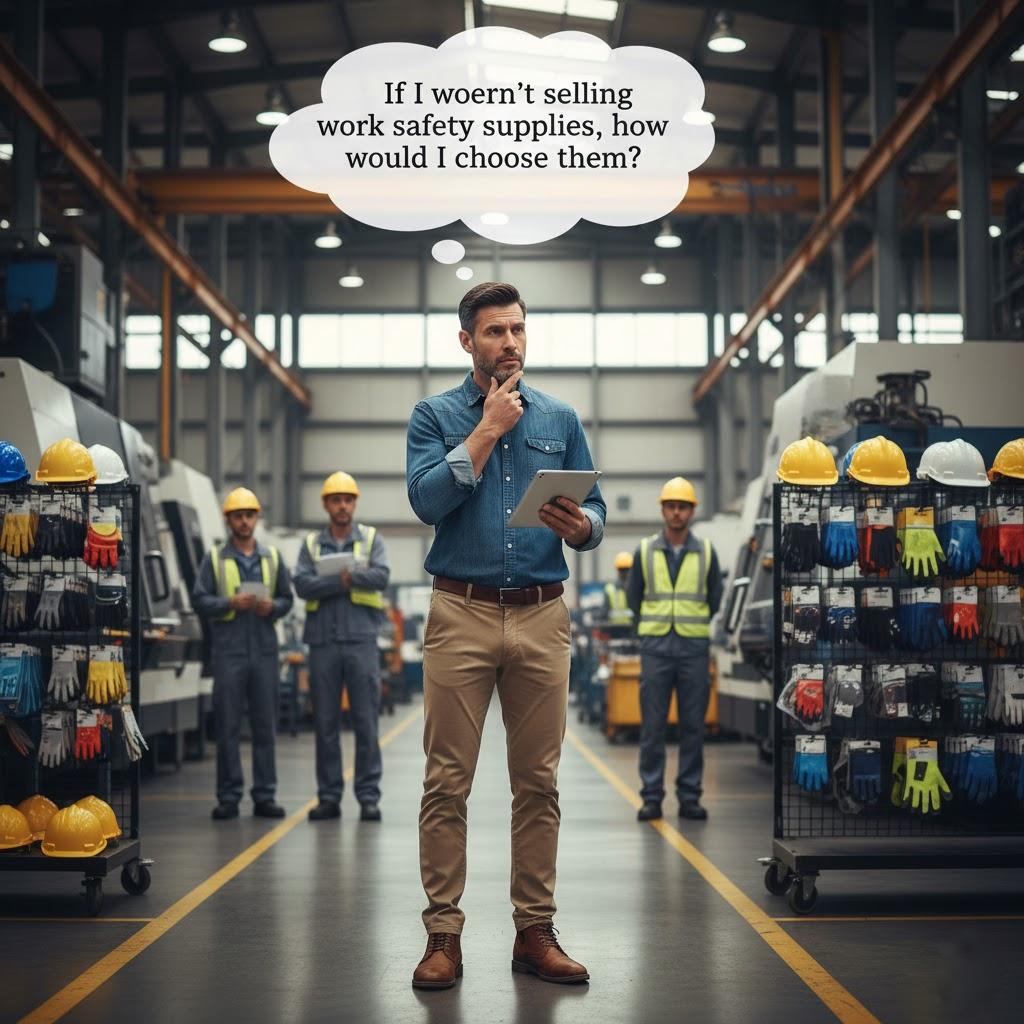
If I weren’t in the personal protective equipment (PPE) business, this would be much simpler.
I wouldn’t need to worry about inventory turnover, model availability, or whether I could sell more of this set. I only need to answer one question:
Can this PPE actually protect people on-site, or just look good on the purchase order?
Having worked in this industry for a long time, you’ll find a very real situation:
Many PPEs are purchased with great professionalism, but used carelessly, yet when an accident occurs, no one can escape responsibility.
Therefore, if one day I no longer sell PPE and am just a regular warehouse/logistics manager, my selection of PPE will likely follow this logic:
First principle: I’ll first look at “would people be willing to wear it,” then “what standards are specified.”
Many buyers like to start with standards:
- EN 388
- EN ISO 20345
- Protection level, abrasion resistance level, cut resistance level…
These are certainly important, but I’ll put them second.
The first priority is always: Would the people on-site be willing to use it?
Reality is harsh:
- Gloves are too stiff, so workers secretly cut their fingertips.
- Shoes are too heavy, so forklift drivers switch back to their own sneakers.
- Goggles fog up, so they’re just hung around the neck as decoration.
A pair of ordinary work safety equipment that is “correctly worn” is always safer than a pair of high-protection work safety equipment left in a corner.
If I didn’t sell work safety equipment, I would spend three days observing the site:
Who removed their protective gear and under what circumstances?
Which actions are most easily “disliked”?
Which work safety supplies are repeatedly complained about?
Only then would I decide what to buy.
Second principle: I don’t believe in “uniform equipment for all,” I only believe in “real differences in job positions.”
Many warehouses like a “one-size-fits-all” approach: One batch of gloves, one model, one pair of safety shoes, all issued uniformly.
From a management perspective, this is convenient;
But from a safety perspective, this is a breeding ground for accidents.
If I didn’t sell work safety equipment, I would be very clear about one thing:
In a warehouse, there are no “universal positions.”
Pickers handle thousands of boxes a day.
Loading and unloading workers mostly push, lift, and drag.
Forklift drivers almost never leave the vehicle, yet their insteps are at extremely high risk.
The safety equipment they need is completely different.
I’d rather buy fewer types than buy the wrong kind.
Because a mismatch is more dangerous than no equipment at all.
Third principle: I focus more on the “reason for failure” than the “lifespan.”
Many companies ask me:
“How long can this last be used?”
If I weren’t selling safety equipment, my counter-question would be:
“What was the reason you last failed?”
- Wear-through?
- Slipping?
- Is it stuffy?
- Does it interfere with operation?
Those who truly understand safety equipment select products based on failures.
- A pair of gloves always tears at the base of the thumb → Indicates incorrect stress distribution.
- Shoes haven’t even worn out, but the person is already complaining of fatigue → Problematic weight design.
- Protective gear isn’t broken, but no one wears it → Failed wearing experience.
I will use these “reasons for rejection” to guide my next purchase.
Fourth Principle: I will assume “an accident will definitely happen.”
Many people choose safety equipment based on the premise:
“We’ve never had any accidents.”
But if I don’t sell safety equipment, I’ll be more pessimistic:
An accident isn’t a question of whether it will happen, but when it will happen.
Therefore, when choosing safety equipment, I ask myself three questions:
- If an accident happens, will this item leave evidence?
- Can it prove that I “have done my best to protect myself”?
- Are there any obvious flaws in the selection?
Because I know:
After an accident, safety equipment will definitely be examined.
Fifth Principle: I don’t pursue “utmost safety,” I only pursue “just right.”
Overprotection is one of the most hidden risks in a warehouse.
- Thick gloves → Reduced dexterity
- High-top shoes → Walking fatigue
- Overly complicated attire → Sharp drop in performance
If I weren’t selling work safety equipment, I wouldn’t pursue “outstanding specifications.”
What I pursue is: Neither hindering work nor allowing risks to run rampant.
The essence of work safety equipment isn’t about wrapping people in “armor,”
but about enabling people to work normally, efficiently, and continuously.
A final, heartfelt statement:
Those who sell work safety equipment easily side with the “product”; but if one day you stand on the side of “after an accident,”
you’ll find:
Truly good work safety equipment is never the most expensive, nor the one with the most impressive specifications,
but rather—you almost don’t feel its presence,
but in critical moments, it’s always there.
Leave a Reply