
A Comprehensive Analysis of the Cost and Value of Stretch Wrapping Machines: Investment, Price, and Return Logic
In modern logistics and manufacturing, **stretch wrapping machines** have become key equipment for improving packaging efficiency, reducing labor intensity, and ensuring the safety of goods transportation. With the improvement of supply chain levels, more and more companies are incorporating them into standardized packaging processes. So, is this type of equipment worth the investment? What is a reasonable price? This article will explore this topic in depth from multiple perspectives.
I. What is a Stretch Wrapping Machine?
As the name suggests, a stretch wrapping machine is an automated device that uses pre-stretched film to tightly wrap goods (usually palletized products). It significantly improves the consistency, strength, and efficiency of packaging, avoiding quality fluctuations and safety hazards associated with manual packaging.
Compared to traditional manual wrapping, this type of machinery has significant advantages in speed, precision, and material savings, and it also frees workers from repetitive manual labor.
II. Stretch Wrapping Machine Price Range: From Hundreds to Hundreds of Thousands
Based on market research and industry pricing data, the price range for stretch wrapping machines is very wide, mainly depending on the level of automation, performance specifications, and application scenarios. Below is a typical price range by category:
1. Entry-level Manual/Basic Packaging Equipment
Some simple manual or portable machines may start at tens to hundreds of dollars, suitable for small items or light industrial applications.
2. Semi-automatic Stretch Wrapping Machines
Typical semi-automatic pallet wrapping machines generally cost around $2,000 – $12,000 USD. These machines require manual placement of the pallet to start, but the packaging process is machine-controlled.
3. High-Performance Semi-Automatic and Fully Automatic Equipment
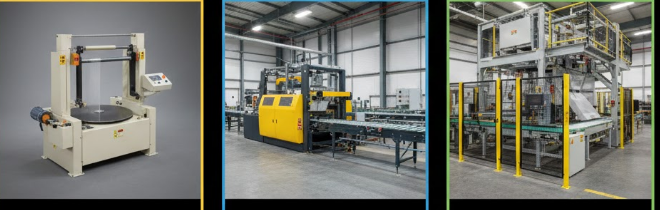
Prices for semi-automatic rotary arm and fully automatic conveyor-type packaging machines increase: $15,000 – $60,000+, with some high-end models exceeding $100,000, especially systems that can integrate with automated production lines.
4. Used and Special Models
Used equipment can significantly reduce investment costs. For example, mature used semi-automatic machines are commonly found in the $3,000 – $6,000 range, but may come with maintenance and repair risks.
III. What Factors Determine the Price?
Understanding the price range is just the beginning; more importantly, it’s about understanding “why there are such large price differences.” Key factors affecting the price of stretch wrapping machines include:
1. Level of Automation
Higher levels of automation typically involve more complex sensors, control systems, and automated mechanical components, thus increasing the price.
- Manual: Basic mechanical structure → Low price
- Semi-automatic: With pre-stretching and control panel → Medium price
- Fully automatic: Automatic pallet lifting/lowering, adjustable speed, integrated with production line → High price
Automation not only affects price but also directly impacts packaging efficiency and material savings, which determine the total cost of ownership in the long run.
2. Functionality and Performance
Additional features such as programmed packaging modes, force control systems, automatic counting, PLC control, and industrial network integration can improve operational efficiency and reliability, but also increase equipment costs.
3. Manufacturers and Brands
Well-known brands in the industry typically have stricter quality control, after-sales support, and technical services, therefore their prices are higher than smaller suppliers, but they are more reliable and easier to maintain in the long term.
4. Procurement Methods and Logistics
Purchasing from overseas can result in lower unit equipment costs, but additional costs such as transportation, tariffs, installation, and warranties need to be considered. Direct overseas purchases may have a lower advertised price, but the final price may not necessarily be more favorable.
IV. Costs are not just about the purchase price
Many people only focus on the “purchase price” of the equipment itself, but the true total lifecycle cost also includes:
1. Installation and Commissioning Costs
Especially for fully automated wiring equipment, installation and commissioning require professional engineers, and the costs are usually not low.
2. Training and Personnel Costs
Employees need to learn operation and maintenance, and this initial investment may be significant.
3. Maintenance and Spare Parts
Good maintenance extends equipment life and reduces downtime losses. Spare parts and preventative maintenance programs are inherently long-term expenses.
4. Packaging Material Consumption
Although not part of the machine price, efficient machines can utilize pre-stretching technology to reduce film usage, thus saving substantial consumable costs in the long run.
Therefore, from a broader perspective, “cost” should be understood as Total Cost of Ownership (TOO) rather than simply the equipment price.
V. How is Return on Investment (ROI) Calculated?
To quantify the worthiness of the investment, a simple example can be used:
Assumptions:
- Daily packaging volume: 100 pallets
- Manual packaging cost (including film + labor): Approximately $3.5/pallet
- Machine packaging cost (including film + labor + depreciation): Approximately $1.45/pallet
- Equipment investment: $15,000
Calculation:
- Daily cost savings: $3.5 – $1.45 = $2.05
- Annual savings based on 250 working days: $512.5 × 250 = ~$12,812.5
- Therefore, it can be deduced that the equipment almost recoups its cost within one year.
This model illustrates that:
Equipment investment is not a one-time cost, but rather an engine for long-term benefits. Its true value lies in cost savings and efficiency improvements.
VI. What kind of companies particularly need such equipment?
While it sounds advanced, not all companies are suitable for immediately investing in high-end automated packaging machines. The following is an applicability assessment:
Suitable for:
- Logistics centers with high daily packaging volume (>50 pallets/day)
- Product lines with simple structures and standard volumes
- Those requiring consistent packaging quality to reduce transportation losses
- Enterprises planning to automate their entire supply chain
Not suitable for:
- Very small or irregular packaging volumes
- Varied product specifications leading to low automation efficiency
- Small startups with very tight budgets
For the latter type of user, semi-automatic or even manual packaging remains a viable option temporarily, but the advantages of automation will become apparent once the volume increases.
VII. Purchasing Recommendations: How to choose the right equipment from a vast array of products?
Below is a practical purchasing list:
1. Define Packaging Needs
Pallet size, weight, packaging frequency
Is automation required to connect with the production line?
2. Determine the Automation Level
Is semi-automation sufficient? Or is full automation required?
3. Focus on Film Efficiency
Choosing equipment that supports high pre-stretch ratios can reduce material costs.
4. Consider After-Sales Service
Installation, commissioning, training, and long-term spare parts supply.
5. Assess Supplier Reliability
Brand reputation, industry standing, and case studies.
6. Comprehensive Cost Assessment
Initial purchase price + installation cost + maintenance + materials + labor.
VIII. Future Trends and Industry Development
With the continuous advancement of industrial automation, stretch wrapping machines are showing the following trends:
Higher Intelligent Configuration
For example, visual recognition, automatic scheduling, and ERP integration.
Big Data and IoT Integration
Real-time monitoring of packaging efficiency and film consumption.
Enhanced Flexibility
Quickly adjusting packaging parameters for different sizes and product types.
These trends all indicate that future packaging will not only be about “stretching,” but also about an automated and intelligent supply chain node.
IX. Conclusion: Price is merely a facade; value is the essence.
In summary, the price of stretch wrapping machines ranges from a few hundred dollars to hundreds of thousands of dollars. Behind this difference lie a series of factors, including automation level, performance, after-sales service, and long-term costs. Understanding their true value requires moving beyond simple price comparisons and focusing on efficiency, savings, reliability, and return on investment.
Whether you are a small or micro-enterprise looking to improve packaging efficiency or a large enterprise planning an automation upgrade, investing in this type of equipment is an important issue worth considering carefully.
Leave a Reply