
Reflective clothing is more than just a simple silver stripe; it’s a life-saving engineering feat based on precise optical principles. To convince readers of its importance, we must delve into the powerful scientific support and profound understanding of human vision behind it.
The Secret of Science—The Magic of Retroreflection
To understand why reflective clothing is so effective, we must first distinguish between ordinary reflection and retroreflection.
1. Ordinary Reflection vs. Retroreflection
Imagine a mirror. When light shines on a mirror, it is reflected at the same angle as its angle of incidence. If the reflected light deviates from the light source (e.g., car headlights), the driver will have difficulty receiving useful information. This is why ordinary white or light-colored clothing offers limited help at night.
Reflective clothing, however, utilizes retroreflection technology.
The Principle of Retroreflection: Whether using tens of thousands of tiny glass beads or more advanced microprismatic structures, the core goal remains the same: to reflect incident light, regardless of its angle of incidence, back along its original path—the direction it was directed towards the light source.
Glass microbeads: Each microbead acts like a tiny convex lens, focusing light and reflecting it off its highly reflective coating, ultimately returning the light along its original path.
Microprisms: Utilizing the geometric properties of a three-sided right-angled prism, light undergoes three reflections before precisely returning to the light source.
Limitations of Human Vision and the Psychology of Reaction
Reflective clothing is crucial because it compensates for inherent deficiencies in human night vision.
1. The Visual System’s “Blind Spot” at Night
In low-light environments, the human eye’s visual system switches from primarily relying on cone cells to relying on rod cells.
Cone cells are responsible for color and high-resolution vision (an advantage during the day).
Rod cells are responsible for black-and-white vision in low-light environments, but at the expense of detail and color discrimination.
This means that at night, our color perception weakens, our ability to capture details slows, our peripheral vision declines, and we are highly susceptible to glare. The extremely high contrast provided by reflective clothing is precisely the signal that rod cells excel at capturing.
2. Conspicuity and Reaction Time
In traffic psychology, conspicuity is a key indicator of how easily an object is spotted. An object (such as a pedestrian) is highly conspicuous when it stands out against a background.
Non-reflective:** Drivers typically need to be about 30 meters (or closer) to effectively spot a pedestrian.
Reflective:** Reflective clothing can extend the detection distance to 100 meters or even over 200 meters.
This extra 70 to 170 meters directly translates into valuable reaction time.
Calculated at a speed of 60 km/h (approximately 16.7 m/s):**
Scenario | Detection Distance (Estimated) | Increased Reaction Time**
Non-reflective | 30 meters | Approximately 1.8 seconds**
Reflective | 150 meters | Approximately 9.0 seconds**
According to traffic safety research, the average human reaction time is approximately 1.5 seconds. In an emergency, the vehicle travels approximately 25 meters within those 1.5 seconds.
For a non-reflective pedestrian, the driver might spot them at 30 meters, but there isn’t enough distance to brake.
For a reflective pedestrian, the driver spots them at 150 meters, leaving 120 meters for reaction and braking, significantly improving safety.
Reflective clothing offers more than just light; it offers time and space.
Ergonomics and Biomotion The design of reflective clothing isn’t random stripes, but rather based on the science of human movement.
1. The Role of Motion Capture Points
Research shows that when the human brain recognizes a moving object, it analyzes the movement patterns of key joints (such as shoulders, elbows, hips, knees, and ankles) to determine if it’s a “person,” not a stationary obstacle. This is called Biomotion Recognition.
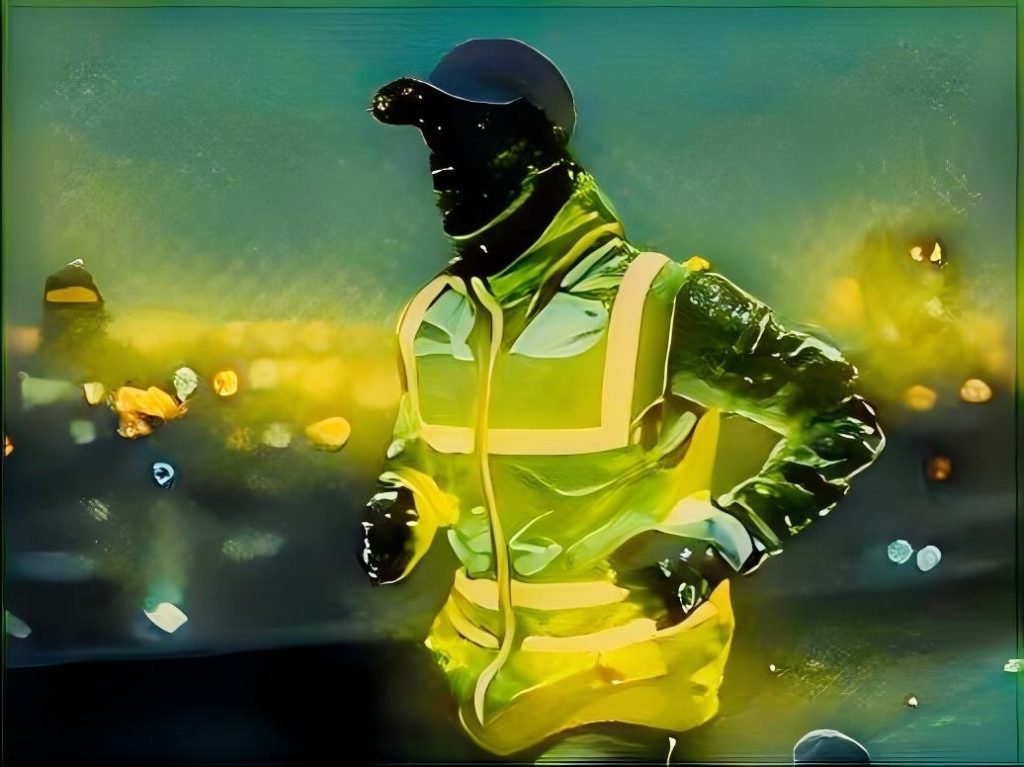
Effective reflective clothing design places reflective materials at these key joint areas, such as: two stripes around the cuffs and hems.
The torso features an “H” or “X” shaped design.
When pedestrians walk, these reflective dots flash and move in a unique, rhythmic manner. Even in poor night vision, the driver’s brain can quickly recognize these moving dots as a moving human figure, rather than a simple reflective obstacle, thus accelerating perception and shortening reaction time.
2. Contrasting Colors and All-Weather Visibility
High-visibility clothing typically combines two materials:
Fluorescent Material: Such as bright yellow or bright orange, used during the day and at dusk. They absorb ultraviolet light from the environment and convert it into visible light, making the color appear brighter than ordinary colors and providing high contrast even in low light.
Reflective Material: Silver-gray, specifically designed for dark environments, relying on external light sources (such as car headlights).
This dual mechanism ensures maximum visibility for the wearer at all times of day (24/7).
Standards and Practices – Ensuring Safety The production and use of reflective clothing are not arbitrary; strict global certification standards ensure their effectiveness.
1. International Safety Standards
For example, the EU standard EN ISO 20471 strictly regulates the following aspects of high-visibility clothing:
* Material Type and Area: Specifies the minimum area that fluorescent and reflective materials must achieve.
* Reflective Brightness: Requires the minimum light intensity performance that reflective materials must achieve under different incident and viewing angles.
* Stripe Layout: Specifies the width and spacing of reflective strips to ensure effective contouring of the human body.
Choosing clothing that has passed these international standard certifications is the cornerstone of ensuring its safety performance. Inferior or non-standard reflective materials may quickly lose their performance after repeated washing, significantly reducing their protective effect.
2. Expanding Applicable Groups and Scenarios
Reflective clothing has long since transcended the exclusive domain of construction workers and sanitation workers. Its applicable group should be expanded to all people exposed to traffic environments:
Runners and cyclists: They travel faster than pedestrians and have higher visibility requirements.
Motorcycle and electric vehicle drivers: Weaving through traffic, side visibility is especially important.
School children: Due to their shorter stature, they are more easily obstructed by the view of large vehicles on their way to and from school.
Pedestrians walking their dogs or strolling at night: Even on city roads with streetlights, a lack of contrast remains a significant safety hazard.
In summary: It’s a safety tool, but more importantly, it’s a respect for life.
The effectiveness of reflective clothing is a perfect combination of precision optics, human visual science, and traffic psychology.
Leave a Reply