
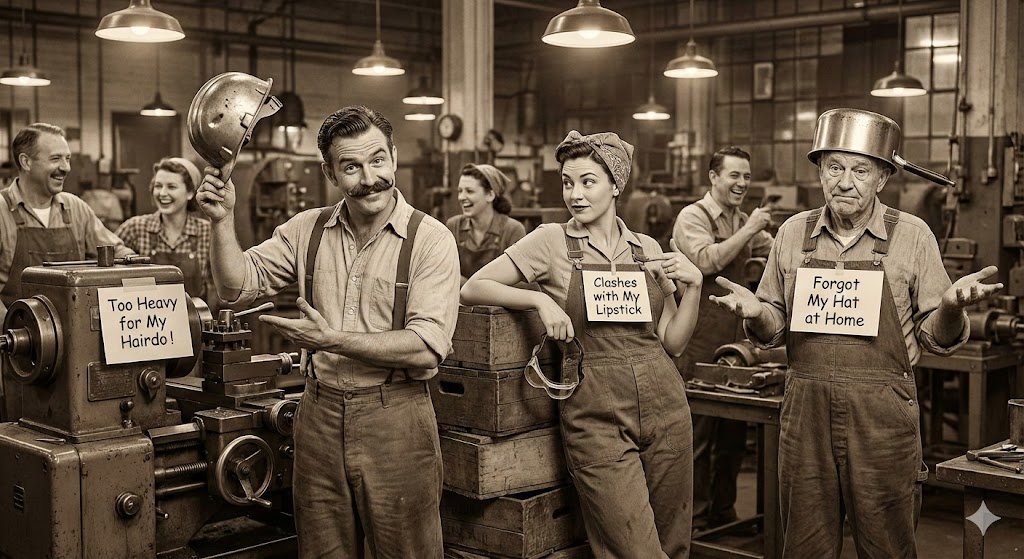
A Collection of Bizarre Reasons We Used to Refuse Personal Protective Equipment (PPE) Over the Years
If you’ve ever worked in a factory, warehouse, construction site, or maintenance line, you’ve probably seen this scene: the safety officer is earnestly explaining safety procedures, while the workers are “using their own methods”—the safety helmet is on their heads, but the chin strap is always loose; gloves are handed out and then disappear in the blink of an eye; goggles are hanging around their necks, but they’re never moved over their eyes.
It’s not that they don’t understand safety, but the reasons they gave for refusing PPE are truly outrageous.
Today, let’s take a look at some of the most memorable scenes of refusing PPE that actually happened on-site over the years. You might laugh while reading, but you’ll suddenly realize: these “funny” reasons are actually not funny at all.
- One: “It’s inconvenient to wear them, I rely on intuition for my work.”
- This is a classic old joke in the PPE world.
- In machining, assembly, and repair sites, you often hear this phrase:
- “Wearing gloves makes it harder to feel the machine. I’ve been doing this for twenty years; I can rely on my instincts.”
These workers are often indeed very skilled and experienced, but the problem is—machines never respect experience.
You’ve avoided countless risks by instinct, but just one mistake:
Not wearing gloves, metal shavings pierce your palm
Careless with cut-resistant gloves, sharp edges directly “kiss” your fingers
In that instant, twenty years of experience can’t outweigh 0.2 seconds of accident.
Sometimes it’s not that “you don’t need safety equipment,” but that you haven’t encountered the moment when you need it.
“It’s too hot; wearing a safety helmet will cause heatstroke.”
Summer is the season when safety equipment is most disliked.
- Safety helmets:
- Stuffy
- Hot
- Pressing down hair
So various “smart ways of wearing them” have emerged:
- Hat on top of the head
- Helmet strap not fastened
Wearing it until the supervisor arrives, then immediately taking it off
But reality is harsh: Real danger never chooses the weather.
High temperatures slow reaction times and decrease concentration, creating ideal conditions for accidents.
Those few minutes you take off your helmet because of the heat are often when the risk is highest.
- To put it bluntly:
- Heatstroke can be managed later, but a head injury may leave no room for regret.
- Three, “Wearing goggles doesn’t look good, makes me look like I came from a lab.”
This is the real feeling of many young workers, especially new employees.
- Wearing goggles:
- Makes you look “unprofessional”
- Afraid of being laughed at by colleagues
- Doesn’t look good in photos
The result is:
Squinting while welding
Tilting your face to the side while cutting
Sparks flying everywhere, all depending on luck
But you may not realize: The eyes are one of the most “delicate” and most easily permanently damaged organs in the body.
Iron filings, dust, chemical splashes—a single accident can cause lifelong damage.
By then, no one will care whether you looked “professional” wearing goggles back then.
“This job will only take a few minutes, no need to make it so complicated.”
If there were a contest for the most dangerous reasons for refusing work, this would definitely be in the top three.
- “Just a couple of twists.”
- “Just a quick move.”
- “Just a quick check, no need to wear it.”
The problem is: Accidents never happen in ten minutes.
- Many workplace injuries occur in:
- Imprompt operations
- Unconventional operations
- The moment you think it will be “almost done.”
What you perceive as “a few minutes” often translates in an accident report as a cold, impersonal statement:
“The worker did not wear protective equipment as required.”
“I’ve never worn it before, and I’m fine, aren’t I?”
This statement sounds convincing, but the logic is extremely dangerous.
- No accident ≠ Safety
- No accident ≠ Correct
Just like running a red light ten times without getting hit doesn’t guarantee you’ll be safe the eleventh time.
Risk doesn’t accumulate in the past; it waits for the future.
The purpose of personal protective equipment (PPE) is not because you will definitely get injured,
but because—once injured, the cost is too high. “The company-issued gloves are terrible, uncomfortable to use.”
To be honest, this is sometimes true.
- Inferior gloves:
- Don’t fit snugly
- Tear easily
- Slippery
- Cheap safety shoes:
- Stiff
- Body-sufficient
- Feet hurt after a day of walking.
- So many people choose:
- “Just don’t wear them.”
But the problem isn’t “whether or not to wear safety equipment,” but whether it’s appropriate.
Truly professional protective equipment should:
- Not hinder operation
- Ergonomically designed
Make people “willing to wear them and able to wear them comfortably.”
If safety equipment is merely something to be “issued and that’s it,” then it’s difficult for it to be respected.
After the initial laughter, you realize it’s not funny at all.
These reasons, taken together, are indeed somewhat laughable.
But you’ll find they have one thing in common: All rejections are using “luck” to fight “risk.”
But the real world never rewards luck.
Safety equipment isn’t a constraint, but rather gives ordinary people another chance to make mistakes.
It’s not that you need it because you’re unprofessional,
but because—even the most professional person makes mistakes.
Conclusion:
A truly mature field operation isn’t about “no one getting injured,” but about “not relying on luck.”
The reasons we used to refuse safety equipment,
in retrospect, might seem laughable now.
But if this article can help someone say one less thing:
“Never mind, I won’t wear it.”
Then these “once-laughable reasons” will have real meaning.
Leave a Reply