
In most companies, the purchasing logic for protective gloves is very simple: choose the most expensive, the thickest, and the highest protection level.
Because this is the safest approach, and also the least likely to lead to accountability afterward.
However, in a real logistics warehouse, this logic was completely shattered.
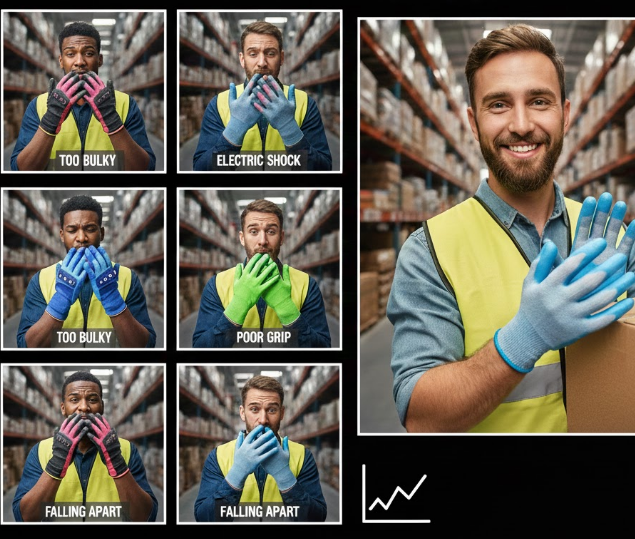
We tested five different types of protective gloves over a year, ranging from a few dollars to tens of dollars per pair, from ultra-thin to heavy-duty cut-resistant. In the end, the one that remained in the long run was surprisingly the cheapest and seemingly the most ordinary model.
Not because of budget constraints,
but because it won in “real-world use.”
Why was the protective glove with the “strongest specifications” the first to be eliminated?
The first batch to arrive was a typical “engineering-grade protective glove”: cut-resistant, puncture-resistant, thick, and abrasion-resistant—the specifications looked perfect.
The purchasing and safety departments were very satisfied.
But a week later, we discovered a danger signal on-site: many workers weren’t wearing them while working.
Not because they forgot, but because—they deliberately removed them.
The reasons are very practical:
- Wearing gloves that are too thick makes gripping cardboard boxes and plastic wrap extremely difficult.
- You can’t feel your fingertips, making scanning barcodes, pressing buttons, and tearing tape awkward.
- They cause stuffiness and sweat in summer and stiffness in winter.
In the high-frequency, fast-paced environment of a warehouse, this discomfort is amplified.
Workers, for the sake of efficiency, will instinctively choose to “take them off first.”
The result:
This “safest” glove actually becomes the most unsafe one in reality.
Why have mid-priced protective gloves become “hidden money-burning machines”?
The second and third types are very common mid-range coated gloves on the market: good grip, professional-looking, and reasonably priced.
Initially, everything was normal.
But a month later, we discovered an anomaly in the warehouse backend data:
For the same job, the monthly consumption of these two types of gloves was 80%–120% higher than that of ordinary gloves.
Where did the problem lie?
- The coating is damaged by tape.
- Oil reduces grip.
- Even a small tear renders it unusable.
Workers may have to change two or even three pairs a day.
The unit price isn’t high,
but with frequent replacements, the total cost skyrockets.
This is the most easily overlooked aspect of occupational safety equipment procurement:
Usage cost > Purchase unit price
Why is the cheapest glove the “perennial favorite in the warehouse”?
The fifth glove doesn’t have any impressive specifications: thin, light, and inexpensive—it looks “ordinary.”
But in real-world environments, it wins on three key points:
1️⃣ Good feel
Workers can feel the box, plastic film, and labels, without affecting operational precision.
2️⃣ Not stuffy or slippery
Even after wearing it for 6-8 hours, there’s no strong urge to remove it.
3️⃣ Low psychological burden
Change it when it gets dirty, throw it away when it’s torn—no delay, no heartache.
The final results are:
- Highest actual wearing rate
- Few workplace injuries
- Lowest average monthly cost per person
What truly determines safety is never the level of protection, but “behavior”
Most safety accidents are not because PPE is not strong enough,
but because—not wearing it, wearing it incorrectly, or wearing it for too long.
In PPE management, there is a severely underestimated formula:
Safety = Protective Capability × Wearing Time
A pair of “high-end gloves” that are removed after 10 minutes is far inferior to a pair of “ordinary gloves” that can be worn for 8 hours.
Why are warehouse and logistics positions more likely to “choose the wrong” protective gloves?
Because warehouses have three characteristics:
- High-frequency operations
- Fast pace
- Extremely high hand involvement
This means:
Comfort, flexibility, and grip are more important than extreme protection.
Job Core Requirements
Sorting: Touch feel, flexibility
Loading/Unloading: Grip strength, abrasion resistance
Forklift: Operational precision
Packaging: Non-adhesive, breathable
Why is “buying expensive” personal protective equipment often a waste of money?
False logic: Expensive = Safety
Correct logic: Suitable = Safety + Cost-saving
Buying the wrong personal protective equipment (PPE) leads to four types of waste:
- Workers not wearing them
- Abnormal consumption
- Increased accident risk
- Increased management costs
While the cheap gloves, because they are suitable, eliminate all these problems.
A crucial piece of advice for purchasing and safety managers:
If you see:
- PPE piling up on-site unused
- Gloves being consumed extremely quickly
- Accidents not decreasing
Don’t blame the employees yet,
Ask this question first:
Is it really effective for them?
FAQ:
Q1: Is it safe to use the cheapest gloves in a warehouse?
As long as the protection level meets the work requirements, comfort and fit are often more important.
Q2: How to determine if the right PPE has been chosen?
Look at the wearing rate, consumption rate, and accident rate, not the product specifications.
Q3: Why are high-end gloves rarely worn?
Because they often sacrifice flexibility and comfort.
Q4: What is the true cost of PPE?
It’s the “cost per person per month,” not the purchase price.
Leave a Reply