
Correct Methods, Techniques, and Common Misconceptions for Inflating Dunnage Bags
In logistics and transportation, dunnage bags are a seemingly simple yet extremely crucial protective device.
Many transportation accidents are not due to the lack of inflatable bags, but rather—incorrect inflation methods.
So the question arises:
How to fill air in a dunnage bag correctly?
Is inflating an inflatable bag really just “plugging in the air gun and filling it up”?
The answer is no.
This article will systematically explain, from the operating procedures, precautions, common mistakes, and professional advice:
How to inflate an inflatable bag safely, effectively, and professionally.
What Is a Dunnage Bag and Why Proper Inflation Matters
What is an inflatable bag? Why is “correct inflation” so important?
A dunnage bag is an inflatable cushioning device used to fill the gap between cargo and containers or truck beds. Its main functions include:
- Preventing cargo from shifting forward/backward or laterally during transport
- Absorbing vibration and impact
- Improving overall transport stability
However, it’s important to emphasize that:
An inflatable bag only works when it’s properly inflated.
- Underinflation → Failure to secure cargo
- Overinflation → Bag bursting, abrasion, and reverse compression of cargo
Therefore, proper inflation directly determines transport safety.
Common Ways to Inflate a Dunnage Bag
What are some common ways to inflate a dunnage bag?
Manual Air Gun
- Commonly found in small and medium-sized warehouses
- Simple operation, low cost
- But air pressure relies entirely on experience
Compressed Air System
- Fast inflation speed
- Suitable for large-volume operations
- Without a pressure regulating device, it’s easy to over-inflate
Dedicated Pressure Regulating Inflation Equipment
- Precise pressure control
- Good inflation consistency
- Mostly used for transporting heavy or high-value goods
Different equipment has completely different operational requirements, which is why many on-site operations “seem to follow the instructions, but problems still occur.”
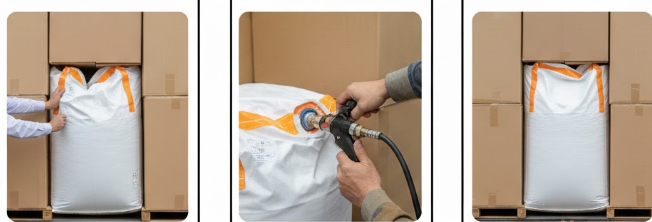
How to Properly Fill Air in a Dunnage Bag (Step-by-Step)
6 Key Steps for Correctly Inflating an Air Bag
Step 1: Confirm the Inflation Valve Direction
- The inflation valve must face outwards
- Avoid being squeezed by goods or the box walls
Incorrect valve direction is one of the common causes of slow leaks.
Step 2: Properly Place the Inflatable Bag, Don’t Force It In
The correct method is:
- First, unfold the inflatable bag
- Let it naturally conform to the goods and the container walls
- Then begin inflating
A Dunnage Bag is for “filling gaps,” not “creating pressure.”
Step 3: Inflate Slowly, Avoid Fully Inflating at Once
Recommended Method:
- Inflate slowly at the beginning
- Pause to observe midway
- Add more air at the end to adjust
If you notice any abnormal bulging in the bag, stop immediately.
Step 4: Determine the “Just Right” Inflation State
A practical criterion is:
Press it with your hand; it should have noticeable elasticity but not collapse.
- Too stiff → High risk
- Too soft → Insufficient fixing force
Step 5: Close the valve and re-inspect
- Confirm the valve is completely sealed
- Gently shake the goods
- Check if the bag has shifted
Step 6: Perform a second inspection after loading
Due to temperature changes affecting air pressure, it is recommended to:
- Re-inspect 10–15 minutes after loading
- Spot inspection of some containers during long-haul transport
Common Mistakes When Inflating Dunnage Bags
5 most common mistakes when inflating dunnage bags
- Thinking “the stiffer the better”
- Using a high-pressure air source without pressure regulation
- Inflation valve obstructed or squeezed
- Inflation bag in direct contact with sharp corners of goods
- No further inspection after inflation
These mistakes are often not operational problems, but rather cognitive problems.
Why Overinflated Dunnage Bags Are Dangerous
Why is over-inflating more dangerous?
Overinflation may lead to:
- A significantly increased risk of bag bursting
- Concentrated localized stress, premature wear
- Uncontrolled internal air pressure when temperatures rise
- Reverse compression of cargo, causing displacement
The correct state of an inflatable bag should be continuous cushioning, not rigid support.
When Dunnage Bags Alone Are Not Enough
When should you not rely solely on inflatable bags?
If the following situations occur, you should reassess your protection plan:
- Extremely heavy single item of cargo
- Irregular gaps and complex stress distribution
- Extremely long sea voyages
- Multiple loading, unloading, and transshipment
In this case, we recommend:
- Using a combination of inflatable bags of different sizes
- Adding anti-slip mats, corner protectors, and straps
- Redesigning the loading structure
Conclusion
In summary: Inflating air bags is not about “filling them completely,” but about “inflating them just right.”
While air bags may seem like just a logistics consumable,
they act as an invisible structural component throughout the entire transportation process.
- Proper inflation means:
- Lower risk of cargo damage
- More stable transportation More professional logistics management
Truly professional operation is never about “using more force,” but about “using the right method.”
FAQ – Dunnage Bag Inflation Questions
Frequently Asked Questions about Inflating Inflatable Bags
Q1: How full should a dunage bag be inflated?
A: Inflate until the bag is full but still elastic; do not aim for the “hardest” inflation.
Q2: Will the air bags leak during transportation?
A: Normally, no, but valve pressure, excessive friction, or over-inflation can cause leaks.
Q3: Are all air bags inflated in the same way?
A: No, air bags of different materials, grades, and load-bearing capacities have different pressure requirements.
Q4: Is there a difference in inflation methods between sea and land transportation?
A: Yes. Sea transportation requires greater consideration of temperature differences and long-term vibration, and over-inflation is generally not recommended.
Q5: Can air bags be reused?
A: It depends on the material, the usage environment, and inspection results. Not all air bags are suitable for reuse.
Leave a Reply