
Your safety deserves to be seen!
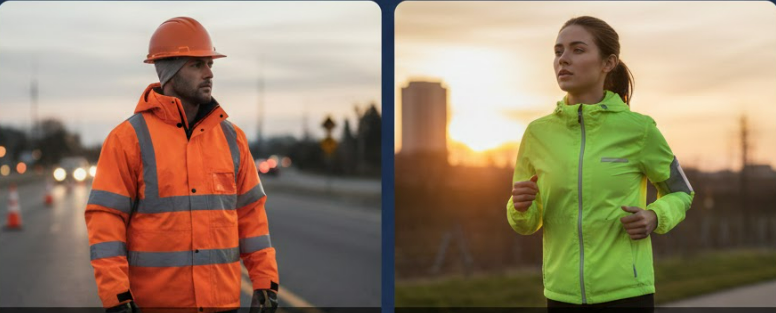
Imagine: Night falls, you’re working on the roadside, or cycling home in the rain or fog. At this moment, your visibility may be the only barrier between you and danger.
For every worker in low-light conditions—whether a logistics sorter, road construction worker, or an outdoor enthusiast at night—you probably share a common pain point: you need a reflective jacket that provides the highest level of safety without breaking the bank. The market offers a wide variety of choices, ranging in price from tens to hundreds of dollars, often leaving us in a dilemma: “cheap ones might be unsafe, expensive ones are too pricey.”
When buying work safety equipment online, the biggest fear is getting a “showpiece.” A reflective jacket is not an ordinary coat; it directly relates to your life safety. You must first understand the following three core issues.
Step 1: Understanding “Life-Saving” Standards—Understanding ANSI/EN ISO Certifications
This is the most important step. The effectiveness of a reflective jacket is not determined by its color and style, but by the certification standards it bears.
1. ANSI Standard (North American System): If you are in the North American market or follow US standards (such as OSHA regulations), you need to check if the jacket meets the ANSI/ISEA 107 standard. This standard determines the minimum area of reflective and background materials on clothing.
Standard Category
Applicable Scenarios
Reflective Performance
Type O
Off-Road Use
Provides only basic visibility, not for traffic use.
Type R
Roadway Use
For workers using fast-moving vehicles; a common standard.
Type P
Public Safety
Designed for police and firefighters, requiring flexibility and visibility.
2. EN ISO Standard (European/International System): If you are in Europe or follow international standards, you need to check the EN ISO 20471 standard.
Key Points to Remember: Whether it’s ANSI or EN ISO, clothing will be marked with a “Class/Level”. This classification is based on the area of the reflective strip, the area of the fluorescent material, and the width of the reflective strip.
Class 1 / Level 1: Lowest level, suitable for slow-moving or non-traffic areas (such as warehouses).
Class 2 / Level 2: Medium level, suitable for roads with speeds below 50 km/h, or for working in inclement weather.
Class 3 / Level 3: Highest level, suitable for highways (above 80 km/h) or extremely inclement weather conditions.
Purchase Recommendation: If your work is near fast-moving vehicles, choose Class 3 / Level 3 directly. Safety is priceless; don’t compromise on this. When purchasing online, if the seller does not clearly display the certification mark and level, abandon the purchase immediately!
Step Two: Differentiating Between “Fluorescent Colors” and “Reflective Strips”—The Art of Material Selection.
Many consumers confuse “fluorescent colors” and “reflective strips,” but their functions are completely different.
1. Fluorescent Material:
Function: Daytime visibility. 1. **This material (usually bright yellow, orange, or green)** absorbs ultraviolet rays from the sun and converts them into visible light, making clothing exceptionally visible in sunlight, especially at dawn and dusk.
Purpose: To ensure you are easily seen during the day.
2. Reflective Material
Function: Nighttime visibility. This material (usually silver-gray stripes) does not emit light, but it reflects light (such as car headlights) back to its source.
Purpose: To ensure you shine like a mirror when illuminated by vehicle headlights at night.
3. Practical Considerations: Material Durability** When shopping online, check the seller’s description of reflective strips. High-quality reflective strips (such as 3M or equivalent products) should specify “washable.” Cheap reflective strips may crack or fall off after a few washes, significantly reducing safety.
Purchase Recommendation: Your jacket must have sufficient fluorescent material and sufficiently wide reflective strips. Look for information about the durability of reflective materials in the product description, as this directly affects the jacket’s cost-effectiveness and lifespan.
Step 3: The Balance Between Comfort and Practicality – Size, Fabric, and Pocket Design.
Even the safest jacket will be unwearable if it’s uncomfortable, rendering the safety features ineffective. Online shopping doesn’t allow for trying on clothes, so you need to be extra careful.
1. Size is Key: Workwear sizing may differ from casual wear. You must refer to the detailed size chart provided by the seller (chest, length, sleeve length). Remember, reflective jackets are usually worn over other clothing (such as sweaters or thick coats), so allow sufficient room in the size. If your work requires a lot of movement, choose a relaxed fit.
2. Fabric Selection: Breathability vs. Water Resistance
For wet/rainy working environments: Choose waterproof fabrics such as PU coating or Oxford cloth, and ensure all seams are taped.
Hot/High-Movement Work Environments: Choose fabrics with a **breathable mesh lining**. While waterproof fabrics sacrifice some breathability, a breathable lining effectively wicks away sweat and prevents stuffiness.
3. Pocket Design and Details: For workers who need to carry tools or walkie-talkies, multi-functional pockets are essential. Carefully check the number of pockets, their size, and whether they have zippers (zippers protect tools from falling out) in online images.
Our core philosophy is “Safety and Peace of Mind on the Go.” Whether exploring nature or at work, we are committed to providing products that protect you and improve your quality of life. We understand that efficiency, comfort, and safety are the foundation of all “journeys.”
Now you have the key knowledge to choose a reflective jacket. Here’s a simple process for purchasing from our website (or other professional workwear websites):
Determine Your Needs Level: Based on your work environment (Class 2 or Class 3), filter for jackets that meet your requirements.
Verify the certification label: On the product details page, find and confirm clear certification images or text for ANSI/ISEA 107 Class 3 or EN ISO 20471 Level 3.
Carefully examine the fabric details: Confirm whether the jacket is waterproof and has a breathable lining.
Measure your own size: Use a measuring tape to measure your chest and shoulder width. Compare the measurements with the size chart on the product details page (not the S/M/L label). If your size falls between the two, it is recommended to choose one size larger to accommodate inner clothing.
Check reflective durability: Look for information about the brand of reflective strips or the number of washes in the description.
Conclusion: Safety shouldn’t be expensive!
Choosing a suitable reflective jacket is not only about complying with regulations but also about respecting life. Affordable doesn’t mean low quality. By arming yourself with professional knowledge, you can find high-quality products online that balance safety standards with reasonable prices.
FAQ: 3-5 related questions and answers
Q1: What is the typical lifespan of a reflective jacket? When do I need to replace it?
A1: The lifespan of a reflective jacket primarily depends on the durability of the reflective strips. Generally, under normal use and washing, high-quality reflective strips can maintain their reflective performance for 50 to 75 wash cycles. If noticeable cracks, peeling, or a significant decrease in brightness under nighttime lighting are observed, it must be replaced immediately, even if the jacket itself appears intact.
Q2: Which is safer, a bright yellow or bright orange reflective jacket?
A2: Both meet high visibility fluorescence requirements and have the same safety level. The choice mainly depends on the work environment:
Bright Orange: Bright orange offers higher contrast in woodlands, snowfields, or areas with large equipment.
Bright Yellow/Bright Yellow-Green: Bright yellow-green offers higher contrast against green or brown backgrounds such as in cities, roads, and grasslands, and is the most common choice for road construction.
Q3: Will a jacket with a company logo affect my certification level?
A3: Yes, but the degree of impact depends on the size and placement of the logo. ANSI/EN ISO standards have strict requirements on the minimum area required for fluorescent and reflective materials. If the logo is too large, occupying the specified area of fluorescent material or covering reflective strips, the jacket may no longer meet its indicated Class rating. When purchasing, ensure the logo is located outside the specified area and that its size meets the requirements of the supplier or certification body.
Q4: Why is there such a large price difference in some reflective jackets? Are affordable products reliable?
A4: The price difference mainly reflects the following aspects:
Certification Costs: Products with formal certifications are more expensive.
Material Quality: High-quality reflective strips (such as 3M) and durable, waterproof fabrics (such as high-density Oxford cloth) are much more expensive than ordinary materials.
Functional Design: Does it have a removable lining, multi-functional pockets, taped waterproof seams, or other complex designs?
If an affordable product can clearly provide an ANSI/EN ISO Class 3 certification, then its core safety functions are reliable. Nature Tour is committed to providing such cost-effective products through optimized supply chains.
Q5: I’m not a professional, can I wear a reflective jacket while riding an electric scooter or walking my dog at night?
A5: Absolutely, and highly recommended! While not legally mandatory, wearing a reflective jacket in low-light conditions significantly improves visibility and ensures your safety. In such scenarios, a Class 2 jacket provides excellent protection.
Leave a Reply