
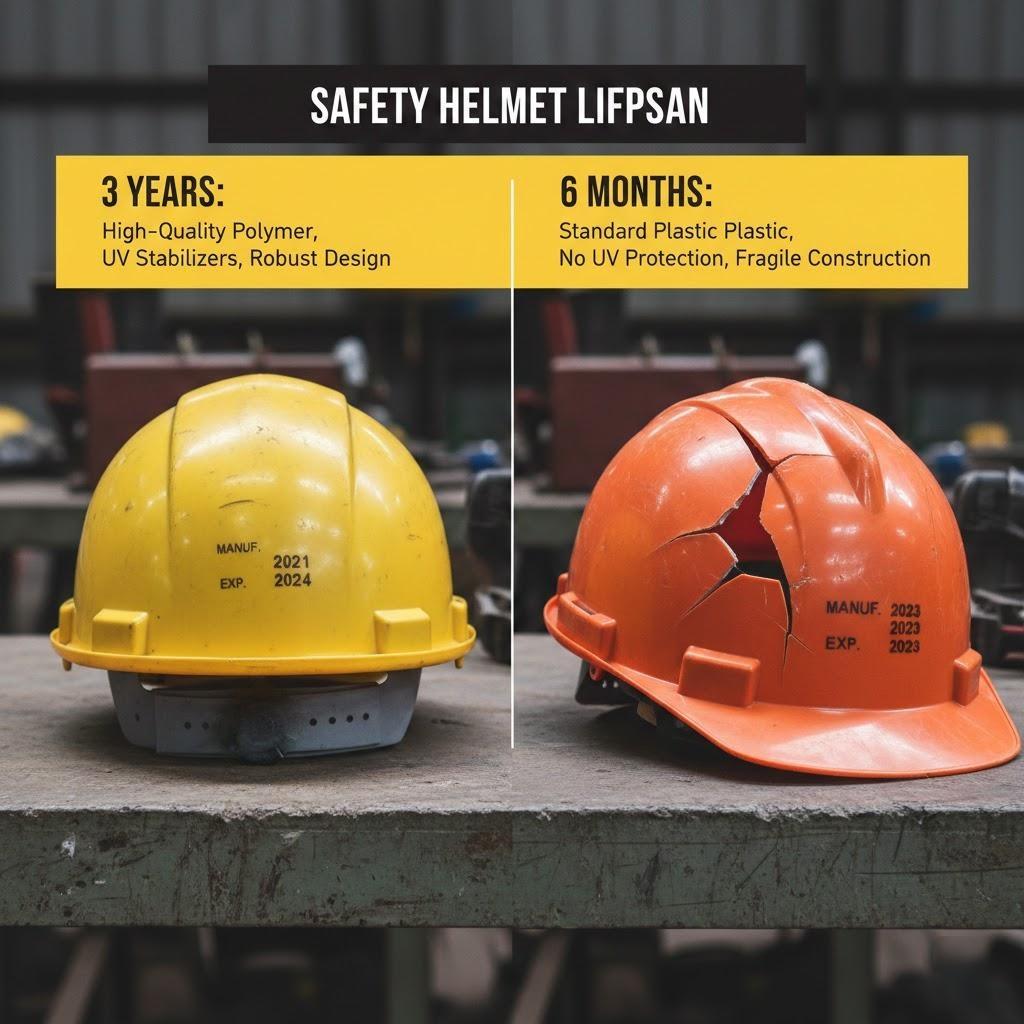
During construction sites, safety training sessions, and factory inspections, we often see this scene: some safety helmets look like they’ve been used for three or four years and are still in good condition; but others, after only a few months, show signs of wear such that the shell turns white, becomes brittle, or even cracks with a slight bend.
Many people believe that safety helmets “can be worn indefinitely as long as they haven’t been hit.”
However, the lifespan of a safety helmet is much more complex than you might imagine—the same product might last three years for some and be scrapped for others in just six months, and there are reasons behind both.
1.Sunlight is the biggest killer of safety helmets.
Most safety helmets are made of plastic (ABS, HDPE, PC, etc.), which are inherently sensitive to ultraviolet (UV) radiation.
Prolonged exposure to sunlight will cause safety helmets to:
The outer shell will turn white and dry.
They will become brittle and crack easily.
They will lose their shine, looking like an “aged” plastic toy.
If you carelessly leave your safety helmet on a car roof, rooftop, or outdoor ground, its lifespan will be drastically shortened.
Typical example: Safety helmets from the same batch may last three years in a warehouse, but only about a year in helmets used for long-term outdoor construction.
2.Chemicals are the second biggest enemy.
Paints, thinners, acids, alkalis, and oil stains will all corrode plastic, causing safety helmets to lose their flexibility.
Especially for painters, chemical plant workers, and auto repair shop workers, the lifespan of their helmets is generally much shorter than on ordinary construction sites.
Some safety helmets may look fine on the outside, but the inside has already been “hollowed out” by chemicals.
3.High and Low Temperatures Turn Safety Helmets into “Crispy Cookies”
Plastics are most vulnerable to drastic temperature changes.
High Temperatures (above 50°C): Accelerate aging and deformation
Low Temperatures (below freezing): Makes helmets brittle and reduces impact resistance
If your work environment is:
A steel structure construction site in summer (40°C)
An open-air site in winter (below -10°C)
Or a high-temperature furnace or hot air area
Then your safety helmet’s lifespan will inevitably be shorter than others.
4.Sweat and Cleaning Methods Also Determine Lifespan.
Many people don’t know that the salt and acidity of sweat can also cause plastic materials to age, especially at the contact points between the headband, shell, and headband.
Even worse, some people use the following when cleaning their safety helmets:
Strong detergents
Alcohol-based cleaning solutions
Industrial solvents
These all accelerate the aging of plastic.
5.Safety Helmets with Hidden Damage That Isn’t Visible on the Surface.
Some safety helmets have been dropped or hit by hard objects; even if the outer shell isn’t cracked, internal cracks may already exist.
These “hidden injuries” may not be visible, but they can cause the helmet to fail at critical moments.
Many accident investigations show that helmets that appear normal on the outside can shatter instantly upon impact because they were previously damaged.
If you’re unsure whether your helmet is still wearable, you can quickly assess it using the following methods:
1.Observe color changes
Any of the following changes are signs of aging:
Whitening, yellowing
Dry, dull surface
Cracks (especially micro-cracks)
If noticeable whitening and micro-cracks appear, replace it immediately.
2.Gently press the outer shell with your hand.
If the following occurs, the material has become brittle:
No elasticity after pressing
A soft “clicking” sound
Slow recovery from deformation
3.Check the connection between the headband and the helmet shell.
These areas are most prone to aging:
Is there any breakage?
Is the buckle loose?
Is the headband hardened or deformed?
4.Check for dents inside.
A helmet that has been impacted may have dents or cracks inside, indicating “hidden damage.”
5.Check the production date (but don’t blindly trust the date).
Generally speaking:
ABS: 2–3 years
HDPE: 3–5 years
PC: around 5 years
However, if exposed to sunlight for a long time, it may become unusable after six months to a year.
In summary:
The same helmet can last three years for some and only six months for others. This isn’t a matter of luck, but rather a difference in environment and usage habits.
-Its lifespan depends on:
-Prolonged exposure to direct sunlight
-Contact with chemicals
-User’s storage and cleaning habits
-Issuance of impacts
-The degree of aging of the headband and shell
If you want your helmet to “live longer,” remember this:
A helmet isn’t something you can just “store away”; it needs to be treated properly.
Otherwise, it won’t protect your head in a critical moment.
Leave a Reply