
When people think of insulating gloves, most immediately picture the thick, conspicuous orange or rubber gloves worn by power workers performing live-line work on high-voltage towers or in substations. They’ve almost become a visual symbol of “electrical safety.”
This association is entirely accurate, but our perspective can be broader. In modern industrial systems, insulating gloves have long transcended the single framework of “electrical protective gear.” Thanks to their superior dielectric properties, chemical stability, and mechanical protective characteristics, they have quietly penetrated many seemingly unrelated fields that demand extremely high safety and precision, becoming a low-key yet crucial “cross-disciplinary protection expert.” Today, we’ll explore their lesser-known but important stages.
Stage One: The “Delicate Operating Table” of New Energy.
Electricity is the traditional domain of insulating gloves, but in the future-oriented field of new energy, they are safeguarding innovation in a new guise.
- Photovoltaic Industry: In the installation and maintenance of photovoltaic power plants, especially in the wiring and maintenance of large centralized inverters and combiner boxes, although the voltage level is usually lower than ultra-high voltage, the potential for high voltage on the DC side and the risk of electric arcing still make insulating gloves standard equipment. They effectively prevent accidents caused by accidental contact with live parts.
- Power Battery Production Lines and Recycling: This is the core scenario for insulating gloves’ “cross-industry” application. Whether it’s the assembly and testing of power battery modules or the increasingly important battery recycling and dismantling process, the risks are extremely high. Residual high voltage may remain inside the battery pack, and short circuits, leaks, or even thermal runaway may occur during dismantling. Insulating gloves provide dual protection here: firstly, electrical isolation to prevent high-voltage electric shock; secondly, their material (such as specially formulated nitrile rubber or neoprene rubber) provides a temporary barrier against corrosive chemicals such as battery electrolytes, giving operators time for emergency response—truly a “lifeline.”
Stage Two: The “Dust-Free Hands” of Precision Manufacturing.
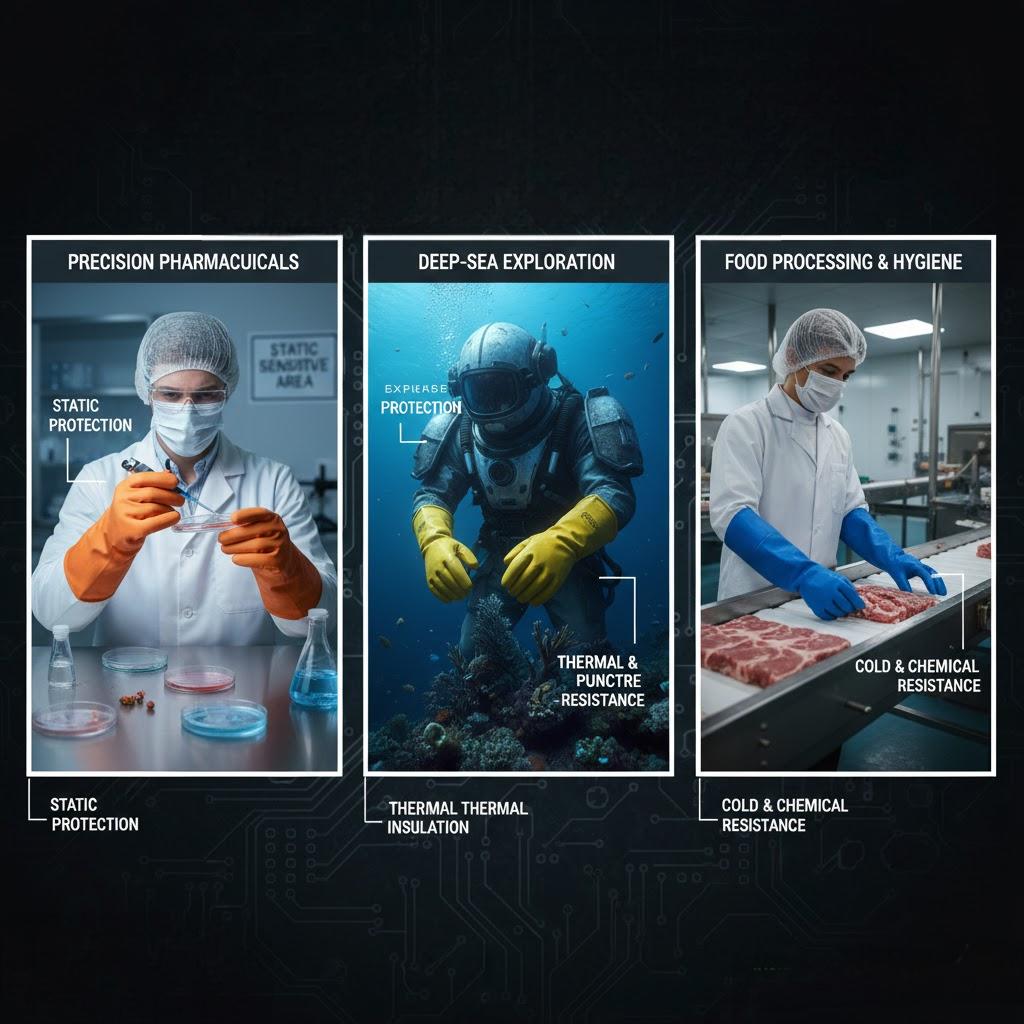
In the cleanrooms of high-precision manufacturing industries such as microelectronics, semiconductors, and precision optical components, even a small amount of static electricity, particulate matter, or chemical contamination can be disastrous. Here, insulating gloves reveal another side of their role.
- Antistatic (ESD) Protection: Many specialized insulating or antistatic gloves used in cleanrooms undergo special surface treatments to control their resistance within safe ranges. They prevent static electricity from the operator’s body from damaging delicate chip circuits and also prevent the gloves themselves from attracting dust due to friction, contaminating wafers or photolithography lenses.
- Chemical Barrier: In semiconductor manufacturing processes such as etching, cleaning, and coating, operators need to come into contact with various strong acids, strong alkalis, and organic solvents. Specialized chemical protective insulating gloves can resist the penetration and corrosion of specific chemicals, protecting the operator’s safety while ensuring that the process is not contaminated by the human body.
Stage Three: The “Universal Shield” in the Laboratory.
The laboratory is a place where exploration and risk coexist. Here, insulating gloves play an even more diverse role, becoming one of the most reliable “partners” for researchers.
- High-voltage experimental equipment operation: Insulating gloves are standard personal protective equipment when conducting experiments involving electrophoresis, capacitor charging, and high-voltage power supply debugging.
- Comprehensive chemical protection: Laboratory chemicals are numerous and unpredictable. A thick, chemically resistant insulating glove (such as butyl rubber gloves) provides basic and crucial protection for hands when preparing solutions and transferring corrosive or toxic reagents. It may not be specifically designed for any particular chemical, but its broad-spectrum chemical resistance serves as the first line of defense against unknown risks.
Stage Four: The “Lifeline” for Special Operations.
In some extreme or special working environments, insulating gloves take on an even greater responsibility.
- Emergency rescue: In the event of traffic accidents (especially electric vehicle accidents), fires, or natural disasters, rescuers face the risk of electric shock from damaged circuits, unknown charged objects, or water-damaged electrical appliances. Rescue gloves with good insulation properties are a prerequisite for entering dangerous areas to conduct search and rescue operations.
- Specific Maintenance Industries: For example, elevator maintenance, maintenance of large industrial equipment (containing complex electrical wiring), and even railway overhead contact line maintenance—where there is a possibility of accidental electric shock, insulating gloves are a standard operating procedure.
The Core Logic Behind Cross-Industry Application: From “Insulation” to “Isolation”.
Why have insulating gloves successfully achieved such a wide range of applications? The core lies in the essential function of “isolation.”
- Electrical Isolation: This is its core function—preventing electric shock.
- Chemical Isolation: By selecting different materials (such as natural rubber, nitrile rubber, neoprene, butyl rubber, fluororubber, etc.), a barrier against the penetration of various acids, alkalis, solvents, and oils is formed.
- Physical Isolation: Providing basic protection against abrasion, cuts, and punctures; some models also offer heat and cold protection.
When a job requires dealing with both electrical and chemical risks, or when working in an environment where “precision” and “danger” coexist, insulating gloves become an efficient and reliable integrated solution. Its “cross-border” application is essentially a microcosm of the evolution of modern industrial safety protection concepts towards comprehensiveness and foresight—no longer just equipping gear for known, single risks, but building three-dimensional protection for complex and ever-changing potential dangers.
Implication: Choice and Respect.
Understanding the wide range of uses for insulating gloves also brings us an important lesson: there are no “all-purpose” gloves, only “suitable” choices.
In different scenarios, gloves of appropriate materials, grades, thicknesses, and sizes must be selected based on specific threats (voltage level, chemical type, mechanical risks, temperature, etc.). Furthermore, regardless of the field of application, the ironclad rule of safety remains unchanged: pre-entry inspection, care during use, regular testing, and timely replacement.
Therefore, remember its new image: it is not only the armor of power industry warriors, but also the shield of laboratory scholars, the tool of new energy craftsmen, and, more importantly, the silent yet steadfast “safety hand” of countless practitioners facing unseen risks. In the symphony of industry, it may not be the loudest instrument, but it is absolutely a crucial beat ensuring the safe conduct of the entire performance.
Leave a Reply