
—Many people don’t pay attention to these things, but without them, a warehouse can barely function.
Many people think of forklifts, racks, conveyor lines, and automated equipment as the most important equipment in a warehouse. While these are indeed the core infrastructure for warehouse operations, the things that are used extensively every day, consumed the fastest, and are most easily overlooked are actually various warehouse consumables.
These consumables are usually inexpensive and seem insignificant, but if they suddenly run out, the efficiency of the entire warehouse can drop instantly. Many warehouse managers have had similar experiences: the equipment is there, the staff is all available, but because of a small shortage of consumables, the shipping pace is forced to slow down.
This article will discuss: the 5 most “low-key but indispensable” consumables in a warehouse. If you are managing a warehouse, logistics center, or e-commerce warehouse, these supplies will appear in your work area almost every day.
Why are warehouse consumables so important?
In warehousing and logistics systems, there is a concept that is often overlooked: high-frequency consumables.
These items typically have three characteristics:
High usage frequency: Used daily, even per shift.
Relatively low unit price: Compared to equipment costs, these products are inexpensive, but their cumulative usage is enormous.
Loss directly impacts operational efficiency: Without inventory, warehouse processes are immediately disrupted.
For example, a medium-sized e-commerce warehouse might consume the following daily:
- Dozens of rolls of packing tape
- Hundreds of meters of stretch film
- Dozens of pairs of protective gloves
Individual products may seem insignificant, but they constitute the “basic materials” for daily warehouse operations.
Next, let’s look at the five most common types.
1. Stretch Film: The “Invisible Armor” Protecting Goods
If you walk into any modern warehouse, you’re likely to see pallets wrapped in a transparent film. This material is stretch film.
It’s almost certainly one of the most frequently used consumables in the warehouse shipping process.
Why is stretch film so important?
During palletized transport, goods frequently encounter:
- Vibration from forklift movement
- Bumping from transport vehicles
- Compression caused by multi-layer stacking
- Dust or moisture in the environment
Without stretch film to secure them, goods on pallets can easily slip, tilt, or even collapse.
The main functions of stretch film include:
- Securing palletized goods
- Preventing scattering during transport
- Protecting goods from dust and moisture
- Improving overall packaging stability
For warehouses with high daily shipping volumes, stretch film is almost irreplaceable.
Why do many warehouses consume stretch film so quickly?
Reasons typically include:
- Different packaging methods
- Manual wrapping vs. machine wrapping
- Differences in goods weight
- Differences in film thickness
Therefore, many warehouses specifically optimize stretch film usage standards to control costs.
2. Packing Tape: The most common packaging material in warehouses
Almost all warehouses use packing tape.
Although it may seem like just a simple roll of tape, its role in the logistics system is crucial.
Core Uses of Packaging Tape
In warehouse operations, tape is typically used for:
- Sealing boxes
- Securing packaging materials
- Reinforcing heavy-duty cartons
- Secondary packaging
Especially in e-commerce warehouses, packaging tape is almost a necessity for every order.
A warehouse shipping an average of 2000 orders per day may consume:
40–80 rolls of tape daily.
This is why many warehouses purchase tape in bulk.
Why Does Tape Quality Affect Efficiency?
Many people assume all tapes are similar, but in reality, there are significant differences.
Low-quality tape may exhibit:
- Insufficient adhesion
- Adhesive layer peeling
- Weak sealing
- Breakage during use
These problems not only reduce efficiency but can also lead to packaging damage during transport.
3. Work Gloves: The Most Easily Overlooked Personal Protective Equipment
In a warehouse environment, employees come into contact with:
- Cartons
- Pallets
- Metal shelves
- Packaging tools
Without suitable work gloves, the risk of hand injuries increases significantly.
Common risks include:
- Scratches on cardboard box edges
- Metal burrs
- Abrasion from prolonged friction
Therefore, most warehouses provide employees with basic protective gloves.
Why is glove consumption so high?
Main reasons include:
High-frequency use
Employees use them daily.
Rapid wear and tear
They are easily worn through when handling goods.
Hygiene and comfort considerations
Many warehouses replace them regularly.
In some logistics centers, gloves are even listed as standard PPE consumables.
4. Utility Knife: An Efficiency Tool
One of the most common small tools in warehouse receiving and picking processes is the container knife.
Although small in size, it directly impacts operational efficiency.
Why are utility knives becoming increasingly popular?
Traditional knives pose certain risks, such as:
- Exposed blade
- Easily injuring employees
- Easily damaging goods
Therefore, many warehouses are now using safety knives, characterized by:
- Hidden blade design
- Automatic spring-loaded mechanism
- Reduced risk of accidental injury
For warehouses with frequent unpacking, a good safety knife can significantly improve efficiency.
5. Safety Floor Tape: Key to Warehouse Order
Warehouse floors often display many colored lines, such as:
- Yellow
- Red
- Black and yellow warning lines
These are usually safety floor tape.
Why are floor markings important?
In warehouses, floor markings are typically used to:
- Divide pedestrian walkways
- Indicate forklift lanes
- Identify hazardous areas
- Mark goods storage areas
Clear floor markings can significantly improve:
- Operational efficiency
- Site management
- Safety level
However, due to frequent forklift traffic, these tapes are also typical consumables.
Many warehouses require regular replacement or maintenance.
Why are these seemingly “low-key” consumables so important?
From a warehouse management perspective, consumables actually play three crucial roles:
1. Maintaining Daily Operational Rhythm
Equipment can be shut down for maintenance, but if consumables run out of stock, many operations will immediately cease.
For example:
- No tape → Cannot seal boxes
- No stretch film → Pallets cannot be shipped
- No gloves → Employee operations are restricted
2. Impacting Warehouse Operating Costs
Although the unit price is low, the usage is enormous.
Many warehouses reduce long-term costs by:
- Optimizing specifications
- Standardizing procurement
- Controlling usage
3. Directly Impacting Safety
Some consumables are closely related to safety, such as:
- Protective gloves
- Safety knives
- Floor warning tape
These products may seem simple, but they are crucial for reducing accidents.
How can warehouses better manage these consumables?
To avoid stockouts and waste, many warehouses adopt simple yet effective methods.
Establish Safety Stock
Set minimum inventory levels for high-frequency consumables, such as:
- Stretch film: at least two weeks’ worth of stock
- Adhesive tape: one week’s worth of stock
- Gloves: fixed replenishment cycle
Standardize Specifications
Reduce the number of SKUs, such as:
- Standardize tape width
- Standardize glove models
- Standardize stretch film thickness
This simplifies procurement and inventory management.
Regularly Evaluate Consumption Data
By recording monthly usage, demand can be predicted more accurately.
Conclusion
In warehouse management, people often focus on large equipment and automated systems, but what truly supports warehouse operations every day are often those inconspicuous consumables.
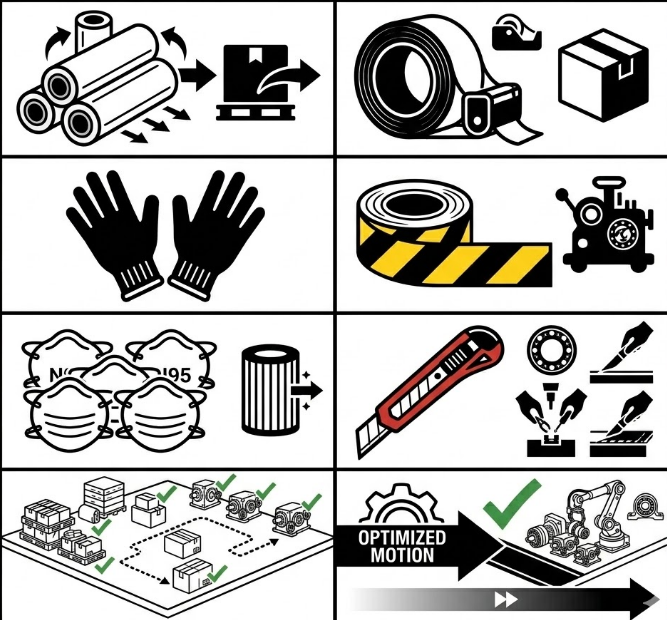
Stretch film, packing tape, protective gloves, box cutters, floor warning tape—these products, though unassuming, are involved in almost every handling, packaging, and shipping operation.
For warehouse managers, the proper selection and management of these consumables can not only improve efficiency but also reduce costs and improve the safety environment.
Sometimes, a smoothly functioning warehouse is not just due to advanced equipment, but also because those seemingly ordinary small items are always in sufficient supply and used properly.
FAQ (Frequently Asked Questions)
1. What are the most common consumables in a warehouse?
Common warehouse consumables include stretch film, packing tape, protective gloves, box cutters, and floor warning tape. These products are used very frequently in daily warehouse operations.
2. Why is warehouse consumable management important?
Because these supplies are used frequently, stockouts can directly impact packaging, transportation, and warehouse operational efficiency.
3. How to reduce warehouse consumable costs?
Long-term costs can be reduced through standardized specifications, bulk purchasing, optimized usage methods, and establishing safety stock.
4. Why is floor warning tape needed in a warehouse?
Floor warning tape helps demarcate aisles, identify areas, and highlight hazardous locations, thereby improving warehouse safety and operational efficiency.
Leave a Reply