
If you walk into a modern warehouse, logistics center, or manufacturing plant, you’re likely to notice an interesting phenomenon: work gloves come in a wide variety of colors.
Some gloves are bright orange, some are blue or green, some are gray, black, or even two-tone designs. Many people, upon first seeing these colors, might wonder—is it just for aesthetics?
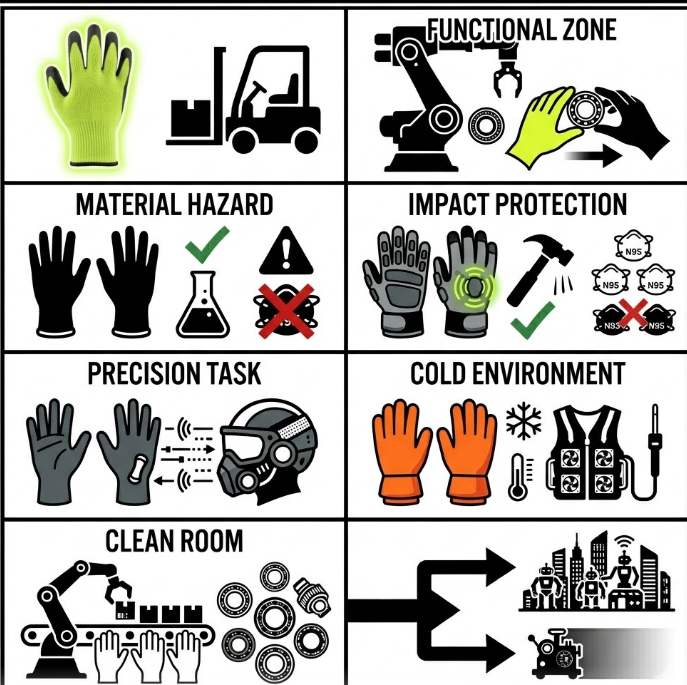
In fact, the color design of work gloves is rarely purely for appearance. In industries such as warehousing and logistics, manufacturing, and food processing, color often serves a crucial function: management, identification, safety reminders, and even contamination prevention.
In other words, the color of a pair of gloves often hides an entire set of work management logic.
Let’s look at why work gloves are designed in different colors.
I. Color Helps Quickly Identify Job Positions
In many warehouses or production lines, workers in different positions may use different types of gloves.
For example:
- Pickers: Non-slip gloves
- Packaging workers: Lightweight protective gloves
- Maintenance personnel: Cut-resistant gloves
- Cold chain operators: Thermal gloves
If all gloves looked exactly the same, management would become extremely difficult. Employees could easily grab the wrong gloves or even use the wrong protective equipment for the wrong job.
Therefore, some companies use color to distinguish job positions.
For example:
- Blue gloves: Packaging positions
- Orange gloves: Forklift or handling positions
- Green gloves: Equipment maintenance positions
This way, managers can quickly determine whether employees are wearing the correct protective equipment simply by “looking at the color.”
This method is especially common in large warehouses because when there are dozens or even hundreds of employees, color identification is more intuitive and efficient than text labels.
II. Color can distinguish protection levels
Besides job position differentiation, color is also frequently used to distinguish the protection level of gloves.
Many cut-resistant glove manufacturers use different colors to represent different protection levels. For example:
- Gray: Basic protection
- Yellow: Medium cut protection
- Dark colors or special markings: High cut protection
While specific standards may vary by brand or region, color does serve as a visual cue.
The benefits of this design are:
Employees don’t need to remember complex model numbers, only colors.
For example:
- “Yellow gloves must be worn during cutting operations”
- “Gray gloves can be used for general handling”
This significantly reduces training difficulty for on-site management.
III. Color Improves Visibility
In warehouse environments, visibility is also part of safety.
For example, in scenarios such as:
- Frequent forklift traffic
- High stacking of goods
- Poor lighting conditions
- Crowded work areas
If the glove color is too dark, the worker’s hand movements will not be easily noticed by those around them or equipment operators.
Therefore, some gloves use highly visible colors, such as:
- Fluorescent orange
- Fluorescent yellow
- Bright green
- These colors are also easily identifiable from a distance.
For example:
When an employee is organizing goods next to a pallet, a forklift driver is more likely to notice their hand movements, thus reducing the risk of a collision.
While this may seem like a small detail, in high-intensity warehouse environments, details often make a difference in safety.
IV. Color Helps Detect Contamination or Damage
Another reason many people don’t know is that color can help detect problems.
For example, in the food or electronics manufacturing industries, hygiene and contamination control are crucial.
If gloves are too dark, such as black or dark gray, some contaminants may not be easily detected.
Therefore, these industries often use light-colored or special-colored gloves, such as:
- Blue
- White
- Light Gray
Blue is particularly common in the food industry because blue foods are rare in nature, making it easy to spot if glove fragments get mixed into the food.
The same principle applies to warehouse work.
If gloves have the following problems:
- Damage
- Coating peeling
- Oil stains
Light-colored gloves are often easier to spot, allowing for timely replacement.
V. Color is also related to materials
Of course, not all colors are designed artificially.
Sometimes, the color actually comes from the material itself.
For example:
- Cotton yarn gloves: usually white or light-colored
- Latex-coated gloves: commonly blue or orange
- Nitrile-coated gloves: commonly black or dark-colored
- Cut-resistant fiber gloves: commonly gray
These materials naturally exhibit specific colors during the production process, thus affecting the final product’s color.
However, many manufacturers now use dyeing or coating techniques to ensure the gloves retain material properties while meeting management requirements.
VI. Color is also a management tool
When we consider the above factors together, we discover something interesting:
The color of work gloves is essentially a management tool.
It can solve multiple problems simultaneously:
- Quickly identify job positions
- Distinguish protection levels
- Improve visibility
- Detect contamination and damage
- Simplify training processes
This visual management approach is crucial in large warehouses or factories.
Because in fast-paced work environments, people don’t have time to read instruction manuals or check model labels.
Color is often the fastest language.
VII. The Safety Logic Behind Tiny Colors
For many ordinary consumers, a pair of gloves may just be a simple tool.
But in professional work environments, every detail often has its own design logic.
From differentiating job positions by color to improving visibility, and then to contamination control, these designs all reflect one principle:
Good personal protective equipment (PPE) should not only protect employees but also help companies better manage safety.
So, the next time you see those brightly colored PPE gloves in a warehouse, perhaps you can look at them from a different perspective.
They are not just gloves of different colors; they are a set of “safety languages” hidden in daily work.
Leave a Reply