
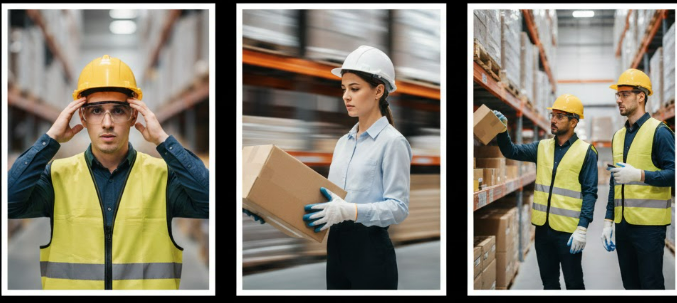
Those entering a logistics warehouse for the first time are often overwhelmed by the scene: goods are moving, people are walking, equipment is running, and everyone is wearing some form of personal protective equipment (PPE).
As a result, newcomers easily have the thought:
“These things all seem quite complicated.”
But after spending some time there, you’ll find—it’s not that the PPE is complicated, but rather that first-time warehouse visitors easily misunderstand it.
The following misconceptions are common among newcomers.
Misconception 1 – “The more protective gear you wear, the more professional you are”
Many new employees, when receiving PPE for the first time, instinctively think:
- Wearing more makes you look more “knowledgeable.”
- More protection is always better.
- Being fully equipped gives peace of mind.
This leads to some typical scenes:
- Even for light physical jobs, they’re fully “armed.”
- Slower movements make them feel less comfortable.
- A day’s work is more tiring than manual labor.
The reality is: Experienced employees often wear “just the right amount.”
In logistics warehouses, those with more experience understand:
- Which positions absolutely require PPE?
- Which scenarios need more protection?
- Which protection is “more of a hindrance”?
In the warehouse, PPE is more like tools than equipment on display.
Misconception Two – All Work Safety Supplies Are Pretty Much the Same, As Long as They Work
The second common misconception newcomers have about work safety supplies is:
“They’re just gloves, shoes, and vests, right? As long as they’re wearable, it’s fine.”
But you’ll soon notice a phenomenon: the longer someone works there, the more selective they become.
Why do experienced employees care more about “ease of use”?
Because in the logistics field:
- The same pair of gloves is used repeatedly many times a day.
- The same pair of shoes is worn for hours at a time.
- Even the slightest discomfort is magnified.
Therefore, experienced employees know very well:
- Which gloves are non-slip?
- Which shoes are comfortable to wear for extended periods?
- Which design allows for the smoothest movement?
In a logistics warehouse, the difference between “usable” and “easy to use” is significant.
Misconception 3 – Personal Protective Equipment (PPE) is Just a “Required Rule,” Not My Own Need
Many new employees’ initial attitude towards PPE is:
- Wear it if the company requires it
- Remember to wear it during inspections
- It doesn’t matter if I put my heart into it
This is a very natural mindset, but it often leads to two results:
- Maintaining comfort even when it’s uncomfortable
- Not adjusting it even if it’s unsuitable
The change often happens the day they “start to care about comfort”
When new employees gradually discover:
- Wearing the right gloves makes their hands less tired
- Wearing the right shoes makes a noticeable difference after standing all day
- A well-designed system makes their movements smoother
They will then realize:
PPE is not about “complying with regulations,” but about making their work easier.
Misconception 4 – Work Safety Supplies Are Issued Once and Can Be Used Indefinitely
In the eyes of newcomers, work safety supplies are often:
- Issued once
- Used until broken
- Not replaced unless broken
But in logistics warehouses, many work safety supplies are actually fast-moving consumer goods.
Looking “still usable” doesn’t mean “good to use”
For example:
- Gloves become thinner, reducing flexibility
- Insoles collapse, feet start to tire easily
- Protective gear loosens, yet they continue to use it
Experienced employees are more likely to notice these changes because they know:
Long-term compromise will only make work increasingly difficult.
Misconception 5 – I’ll just copy how others use them
When newcomers enter the warehouse, the most direct way to learn is by imitation:
- See how experienced employees wear them
- See which type everyone uses
- See who uses them the most
But the problem is: What suits others may not suit you.
The same personal protective equipment (PPE) can be used in completely different ways.
Reasons include:
- Different height and body types
- Different work intensity
- Different job movements
When experienced employees are already accustomed to a certain method, new employees may find it:
- tiring
- awkward
- unable to perform effectively
Experience your own usage first, then refer to others; efficiency will be much higher.
Misconception Six – PPE affects efficiency and is an “extra burden”
Many new employees initially feel:
- Wearing an extra item adds an extra step
- Wearing PPE slows down movements
But the reality is often the opposite.
When PPE is used correctly:
- Hands don’t slip, making operations more stable
- Feet don’t tire, allowing for more sustained rhythm
- The body is more relaxed, resulting in higher efficiency
What truly affects efficiency is not the PPE itself, but unsuitable or awkward PPE.
A Guide for First-Timers in a Logistics Warehouse
If you’re new to logistics warehouses,
regarding personal protective equipment (PPE), remember these three points:
- Don’t aim for the “most complete,” aim for the “suitable.”
- Don’t treat it as a task, treat it as a tool.
- If it’s not convenient or comfortable, you can adjust it.
When you start paying attention to these details,
you’ll find that: PPE is no longer a burden, but a “partner” that helps you complete your day smoothly.
Conclusion
It’s normal to have misunderstandings about personal protective equipment when entering a logistics warehouse for the first time.
The truly important thing isn’t to “understand everything at once,”
but to gradually find the most suitable method for yourself through use.
This is the beginning of becoming an expert from a novice.
FAQ:
Q1: What basic personal protective equipment (PPE) is typically needed for new employees in a logistics warehouse?
It usually includes basic protective gloves, safety shoes, and reflective vests. Specific requirements may vary depending on the job position.
Q2: Is more expensive PPE always better?
Not necessarily. The key is whether it suits the job and the employee’s usage habits. Ease of use is more important than price.
Q3: Why are experienced employees more selective about PPE?
Because after prolonged use, any discomfort will be amplified. Suitable PPE can significantly reduce fatigue.
Q4: How often should PPE be replaced?
There is no uniform standard. It should be judged based on usage frequency and actual experience. Replacement should be considered when PPE becomes inconvenient or uncomfortable.
Leave a Reply