
In many logistics warehouses, the procurement of safety shoes is often simplified to one sentence:
“Just buy anti-slip and anti-impact shoes.”
But in reality, you’ve likely seen these situations: The same pair of safety shoes is praised by employees in warehouse A as “stable, easy to walk in, and not tiring,” but criticized in warehouse B as “slippery, hard, and causing blisters”; some warehouses need to replace shoes every three months, while others can last a year; some areas have frequent accidents, while the neighboring warehouse has almost no slip-and-fall records.
The real difference is often not brand or price, but an often overlooked factor—ground conditions.
In logistics and warehousing environments, over 90% of walking, handling, and accidents occur between the ground and the soles of shoes.
If you ignore the ground, even the most professional safety shoes will be ineffective.
Why is “ground type” the most important factor in selecting safety shoes?
From a physics perspective, a person’s walking stability depends on:
The coefficient of friction between the sole and the ground + the contact area + the force-bearing structure. Different floor surfaces have completely different friction characteristics:
- Floor Characteristics | Shoe Requirements
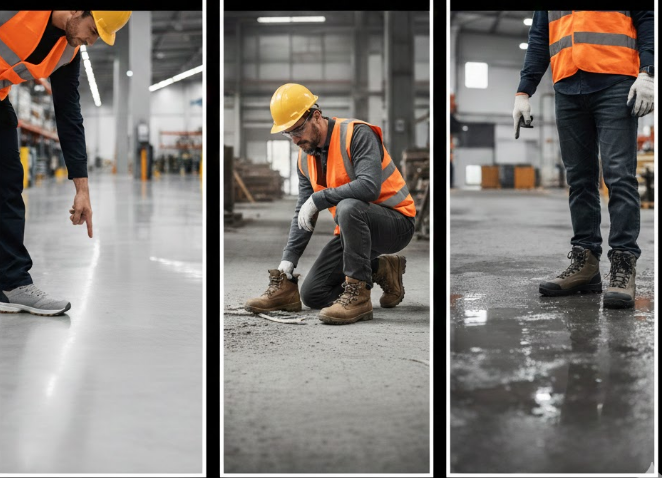
- Epoxy Flooring | Smooth, hard, low coefficient of friction | Requires high friction, soft and close-fitting soles
- Cement Flooring | Rough, hard, high abrasion | Requires wear resistance + cushioning
- Damp Flooring | Has a water or oil film | Requires waterproof, oil-proof, drainage, and slip-resistant soles
Using the same type of safety shoes for all three types of flooring is essentially putting employees to work under incorrect physical conditions.
What kind of safety shoes should you choose for epoxy flooring?
Epoxy flooring is commonly found in:
E-commerce warehouses, automated warehouses, sorting centers, modern logistics parks.
It looks clean and flat, but it’s one of the easiest surfaces to slip on.
Why are epoxy floors prone to accidents?
Because its surface is smooth, ordinary shoe soles cannot “grip” the ground.
Many safety shoes labeled “slip-resistant” are actually designed for cement floors and perform poorly on epoxy floors.
Key Points for Correct Shoe Selection
1. The sole material must be high-friction rubber or anti-slip PU.
Hard rubber offers almost no grip on epoxy flooring, while flexible rubber or specialized anti-slip PU provides a larger contact area.
2. The tread pattern should be fine, not large serrations.
Many anti-slip shoes have large serrations, which are designed for muddy or outdoor surfaces, and will actually reduce friction on smooth surfaces.
3. The sole should have “micro-deformation capability.
” Shoes should be able to slightly conform to the ground when stepped on to truly prevent slipping.
Suitable for: Pickers, sorters, checkers, and automated passageway inspectors.
How to Choose Safety Shoes for Cement Floor Warehouses?
Cement floors are standard in older warehouses, loading and unloading areas, and platforms.
Their biggest characteristic is not slipperiness, but rather: hardness, roughness, and abrasion.
The Real Challenges of Cement Floors for Shoes
- Shoe soles wear out extremely quickly.
- Prolonged walking can cause foot fatigue.
- Pallets, nails, and steel straps can easily puncture shoe soles.
Key Points for Choosing the Right Shoes
1. The sole must be highly abrasion-resistant. Ordinary PU soles may wear down in three months on cement.
You need abrasion-resistant rubber or rubber composite soles.
2. The midsole must have a cushioning structure.
Without cushioning, walking 10,000 to 20,000 steps a day on cement is like “walking on stones.”
3. Impact and puncture resistance are essential.
The risks here are real, not just theoretical.
Suitable for: Loading and unloading workers, forklift operators, heavy goods handlers.
How to Choose Safety Shoes for Wet Floors and Cold Storage Environments?
The biggest risks to floors in cold storage, fresh food warehouses, food warehouses, and cleaning areas are: water film + oil film.
Many shoes are not slippery on dry floors, but become almost ineffective when wet.
Key Points for Correct Shoe Selection
1. Must have an oil- and water-resistant rubber sole.
Ordinary PU soles become slippery on water; only oil-resistant rubber is reliable.
2. The sole must have a drainage pattern.
This allows water to be squeezed out, not trapped underneath.
3. The upper must be waterproof and leak-proof.
Wet feet can cause gait distortion, making slipping more likely.
Suitable for: Cold storage operators, fresh produce sorting, and cleaning staff.
Why does “providing everyone with one pair of safety shoes” almost always cause problems?
Because a warehouse typically contains:
Epoxy flooring + concrete floors + damp areas.
Using one pair of shoes for all surfaces results in:Incorrect fit in certain areas.
Ultimately, employees will either complain, refuse to use the shoes, or accidents will occur.
FAQ:
Q1: Are more expensive safety shoes always better?
No. If you choose the wrong surface, even the most expensive shoes will be slippery, tiring, and prone to damage.
Q2: Can I buy shoes based solely on their anti-slip rating?
No, anti-slip ratings don’t differentiate between surface types.
Q3: Are special shoes required for cold storage?
Yes, ordinary anti-slip shoes will be ineffective on wet surfaces.
Q4: Is anti-slip the most important factor for concrete floors?
No, wear resistance and cushioning are more important.
Q5: Can I buy only one type of safety shoe?
Yes, but only for warehouses with high accident rates and rapid wear and tear.
Leave a Reply