
—What you think is safer is actually more prone to problems
In many companies’ occupational safety management systems, there’s a seemingly impeccable logic:
Key positions must be given the best and safest protection.
So, protection levels are maxed out, procurement is worry-free, and the system seems perfect.
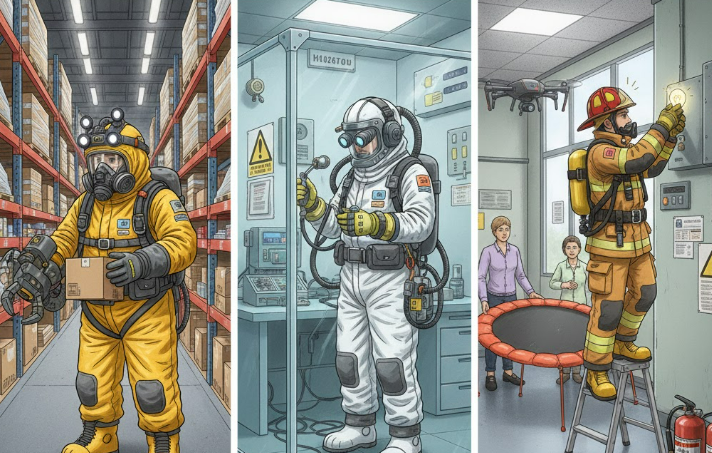
But when you actually go to the site, you’ll find a subtle phenomenon: The more “prioritized” a position is, the more likely protective equipment is to be used improperly, for short periods, or even secretly replaced.
The problem isn’t with “prioritizing safety” itself,
but rather—some positions are genuinely prone to “overprotection.”
I. Warehouse Picking/Handling Positions:
Higher cut protection levels actually decrease both efficiency and safety.
This is the most common and most easily overlooked position.
Why is it prone to “overprotection”?
In many managers’ minds, warehouse work means:
- Many cardboard boxes
- Sharp edges
- Frequent handling
So the logic is natural:
“Use high-grade cut-resistant gloves; it’ll definitely be safer.”
But the reality is often—
- Gloves that are too thick make it difficult to grip boxes
- Decreased finger dexterity
- Excessive sweating makes gloves slippery
What are the results?
- Employees are more likely to drop items
- Increasing the risk of injury to feet and hands
- Glove usage drops rapidly
What are the real risks?
For most warehouse picking positions, the main risks are:
- Minor scratches
- Friction
- Insufficient slip resistance
Not the risk of high-intensity, continuous cutting.
A more reasonable protection approach
Instead of blindly pursuing the highest cut resistance, focus on:
- Finger dexterity
- Slip resistance
- Breathability and comfort
Gloves that can be worn all day without disrupting the work rhythm
are the truly “safe” choice for this job.
II. Precision Assembly/Sorting Positions:
The More “Hardcore” the Protection, the Higher the Risk of Misoperation
This is the second position that is very easily misjudged.
Common Misconception:
“As long as it’s a production line, protection should be adequate.”
So you’ll see:
- Thick gloves
- Heavy protection
- High-level standards all at once
But the true characteristics of precision assembly positions are:
- Frequent operations
- Delicate movements
- Highly sensitive to touch and feedback
Problems caused by excessive protection
When protective gear is too thick or too hard:
- Parts are difficult to handle
- Insensitive touch
- Easier to assemble crookedly, incorrectly, or slip off
These problems are safety hazards in themselves.
Many minor bumps, rework, or even equipment damage on-site
are not due to “insufficient protection,”
but because the protection interferes with the operation itself.
A More Reasonable Protection Approach
For these positions, the key words for protection are not “strongest,” but rather:
- Close fit
- Sensitivity
- No impact on precision
The goal of protection is to reduce unnecessary harm, not to create new operational risks.
III. Short-Term High-Risk Exposure Positions:
“All-Weather Protection” Inadvertently Makes It Ineffective in Real Danger
The problem with this third type of position lies in the exaggerated usage scenarios.
Typical scenarios include:
- Occasional exposure to noise
- Discontinuous dust
- Short-term special operations
Many companies’ approach is:
“Since there’s a risk, wear the highest level of protection at all times.”
This sounds correct, but in reality, it often results in:
- High breathing resistance, causing employees to remove it prematurely
- Uncomfortable to wear, rendering the protection ineffective
- When truly needed, it’s not worn properly.
The key issue is:
The risk is “phased,” but protection has been “normalized.”
Human tolerance for discomfort is limited.
When protection becomes a burden,
employees will “self-optimize” in ways you can’t see.
A More Reasonable Protection Approach
For these positions, a more effective approach is:
- Clearly define “when it must be worn”
- Provide easier-to-wear, lighter solutions
- Focus on “effective protection in critical moments”
It’s not about wearing it for longer, but about wearing it correctly.
IV. Why is “over-protection” so common in companies?
Ultimately, it’s not because managers are unprofessional,
but because of three very real reasons:
1️⃣ Standard-oriented, not job-oriented. Choosing the safest option minimizes psychological pressure.
2️⃣ Fear of responsibility, not fear of ineffectiveness. “Higher level” is easier to explain than “appropriate.”
3️⃣ Ignoring human feelings. But it is precisely “people” who determine whether protection is truly effective.
V. Protection is not about who is the most ruthless, but about who is the most suitable.
Truly mature occupational safety management often shares a common characteristic:
They don’t blindly believe in “highest level,” but respect job differences.
- Protection serves the job.
- Work should not be hindered by protection.
When protective equipment and job requirements are truly matched,
you’ll find:
- Employees are more willing to use it.
- Fewer violations.
- Furthermore, fewer accidents.
Safety is never “piled up,” but “developed through use.”
Leave a Reply