
Many warehouses make a seemingly reasonable mistake when configuring personal protective equipment (PPE): use the same set year-round and replace it when it breaks.
However, anyone with experience in warehouse safety management knows that the risk dynamics in winter are completely different from those in summer.
If you use the same PPE to handle all four seasons, accidents are only a matter of time.
This isn’t about spending more money; it’s about a systemic misalignment.
First, seasonal changes alter the “type of injury.”
Many people understand seasonal differences only as “cold/hot,” but in a warehouse environment, the real change is the injury structure.
Risks More Common in Summer:
- Slippery hands, leading to grasping errors.
- High temperatures and sweat, causing employees to remove protective gear without authorization.
- Sweat buildup in shoes, causing slippery feet.
- Prolonged wearing of non-breathable protective gear leads to fatigue.
Problems More Typical in Winter:
- Stiff fingers, decreased reaction time.
- Heavy clothing affects vision and movement.
- Damp or condensing ground increases the risk of slipping.
- “Too thick” protective gear can actually impair fine motor skills.
👉 The conclusion is clear:
- Summer protection prevents “loss of control,”
- while winter protection prevents “sluggishness.”
II. Why is “one set of protective gear per year” particularly dangerous in winter?
Many warehouse accidents in winter are not due to not wearing protective gear, but because wearing it incorrectly.
Typical Scenario 1: The thicker the gloves, the higher the risk of accidents.
In winter, to keep warm, employees directly switch to thicker cotton gloves, but the result is:
- Loss of grip
- Delayed operation
- Employees simply remove them.
Winter protection ≠ Safety protection.
Typical Scenario 2: Safety Shoes Keep You Warmer, But Make You More Slippery
Some winter safety shoes only enhance warmth, neglecting:
- Slip resistance in low temperatures
- Grip ability of the sole in cold storage/wet surfaces
Typical Scenario 3: Thick Workwear Obstructs Vision
- Hoods obstruct side views
- Thick coats restrict shoulder movement
- Slower turning speed increases blind spot risk for forklifts
III. The core logic of winter safety protection is not “thicker,” but “more stable”
A truly effective winter safety protection system focuses not on warmth, but on three key words:
1️⃣ Stability (Grip & Control)
- Gloves should provide both warmth and grip
- Sole should maintain elasticity at low temperatures
- Protection should not affect fine motor skills
2️⃣ Reaction Speed
- No increase in operational delay
- No change in existing movement habits
- Employees should be able to use it “instinctively”
3️⃣ Sustainable Wear
- Not stuffy, not stiff, not tiring
- Employee willingness to wear is more important than mandatory wearing.
IV. Summer Safety Focus: The Opposite
If winter emphasizes “stability,”
then summer emphasizes **”freedom”**.
The three biggest concerns with summer safety equipment are:
- Lack of breathability
- Too stuffy
- Heavy wearing burden
The result is often:
- Employees secretly remove them
- Wear them halfway
- “Wear them again when the inspection comes”
What should truly be emphasized in summer is:
- Breathable materials
- Sweat-wicking design
- Lightweight protective structure
👉 Safety depends on employees’ willingness to wear them continuously.
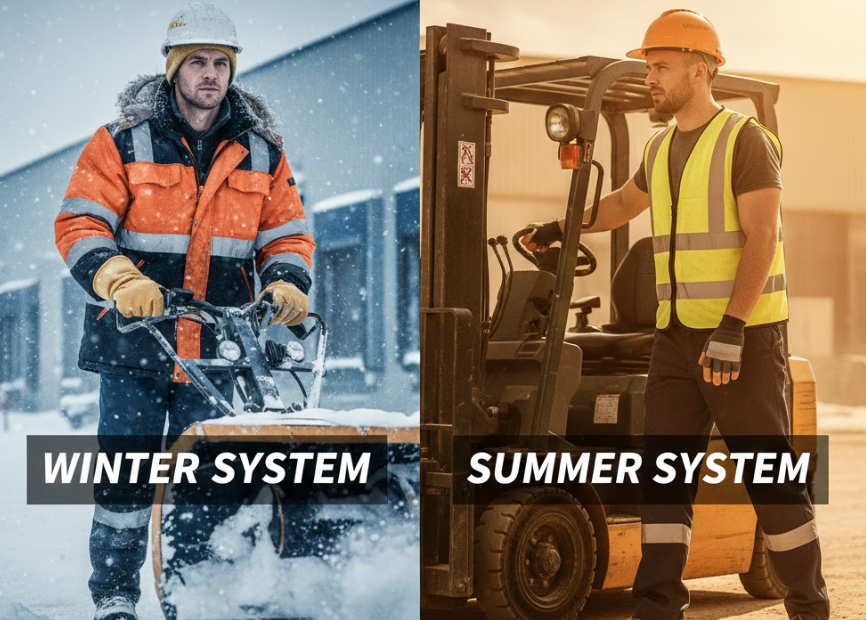
V. Two Systems, Not Two Individual Items
Many warehouses ask:
“Can’t we just buy more pairs of gloves in winter?”
The answer is: Far from enough.
Summer work safety systems typically revolve around:
- Lightweight safety shoes
- Highly breathable gloves
- A protective structure that is non-slip yet not stuffy.
Winter work safety systems need to be reconsidered:
- Cold-weather yet lightweight hand protection
- Shoe soles that remain non-slip even in low temperatures
- Workwear design that doesn’t restrict range of motion.
This is a complete, coordinated system, not just “changing to thicker clothing.”
VI. Why do many warehouses experience more accidents in winter?
The reason is usually not employee laziness, but rather that management overlooks three things:
- Failure to conduct seasonal transition assessments
- Using summer operating standards
- Replacing “safety logic” with “warmth logic”
The real danger in winter is:
“It looks fine, but it’s actually already half a step behind.”
VII. How to determine if your winter work safety system is “mismatched”?
You can quickly self-check these questions:
- Do employees remove their gloves more frequently in winter?
- Are there any cases of “no falls, but sprains”?
- Do you notice a significant slowdown in the work pace?
- Are there more minor accidents in the same job during winter?
If the answer is “yes,”
then the problem is likely not with the employees, but with the occupational safety and health (OSH) system itself.
VIII. In conclusion: Truly professional warehouses have “seasonal versions.”
Mature warehouse safety management typically does one thing: treats OSH as “operational tools that upgrade with the seasons.”
It’s not about spending more money,
but about spending money at the right time.
Winter OSH is for keeping people “stable while sluggish”; summer OSH is for keeping people “alert while fatigued.”
These should inherently be two separate systems.
Leave a Reply