
The real difference between four-point and five-point seat belts is more than just “one more strap.”
In many industries—warehousing and logistics, engineering vehicles, industrial equipment, racing cars, child safety seats, special operations platforms—**seat belts** are often considered standard equipment, yet rarely truly understood.
Especially when you see product descriptions like:
- 4-point harness
- 5-point harness
Most people’s first reaction is:
“Isn’t it just a difference of one more or one less strap?”
But in the field of safety engineering, this understanding is extremely dangerous.
In fact, four-point and five-point seat belts address completely different levels of risk.
Their differences involve human dynamics, collision energy distribution, skeletal force paths, and failure mode design.
This article will start with “Why are multi-point seat belts needed?” and clearly explain the essential differences between four-point and five-point belts in one go.
I. Why upgrade from “two-point” to “multi-point”?
To understand the difference between 4-point and 5-point seat belts, we must first answer a more fundamental question:
Why are ordinary two-point or three-point seat belts insufficient?
1. The Real Movement of the Human Body in an Accident
When equipment suddenly decelerates, rolls over, or is impacted, the human body doesn’t simply “move forward as a whole,” but rather:
- The upper body leans forward
- The pelvis slides forward
- The spine is compressed
- Internal organs continue to move forward due to inertia
If the lower body is not effectively restrained, a typical phenomenon occurs:
Submarining—the body slides forward as if “slipping under the seat belt.”
This is one of the root causes of serious injury.
2. The Core Goal of Multi-Point Seat Belts
The design goal of multi-point seat belts is not “to be tighter,” but rather:
- To distribute the impact force to the parts of the body most capable of withstanding it
- To control the body’s movement path
- To prevent slippage, rollover, and localized overload
- To maintain posture stability even in extreme situations
This is the significance of 4-point and 5-point seat belts.
II. What is a 4-Point Harness?
1. Structural Definition
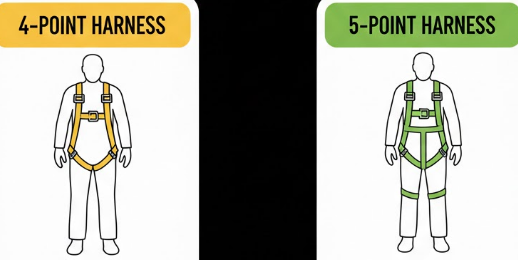
A 4-point harness typically consists of four straps:
- Left shoulder strap
- Right shoulder strap
- Left lap belt
- Right lap belt
All straps converge at a central buckle, forming a stable load-bearing system.
2. Design Logic of 4-Point Harness
The core idea of a 4-point harness is:
By fixing the shoulders and both sides of the pelvis, it restricts the forward movement of the upper body and pelvis.
It mainly addresses:
- Forward leaning of the upper body
- Side swaying
- Body displacement during rollover
It is very common in the following scenarios:
- Racing cars
- Construction machinery seats
- High-speed industrial equipment operating positions
- Some special vehicles
III. Advantages and Limitations of 4-Point Harness
1. Advantages of 4-Point Harness
(1) The fixing effect is significantly better than that of a 3-point harness
- Symmetrical force on both shoulders
- More even force on the chest cavity
- Better protection against rollover and side impact
(2) Relatively simple to wear and adjust
- One less strap than a 5-point harness
- Fastest to wear
- Low maintenance cost
(3) Better adaptability to adult body types
- Especially suitable for adults with stable body types
- Does not rely on the groin anchor point
2. Key Limitations of 4-Point Harness
This is also something many people overlook.
A 4-point harness does not completely prevent “slip-over.”
Under high deceleration impacts:
- The pelvis may still move forward.
- The body may slip under the lap belt.
- Impact force concentrates in the abdominal soft tissue.
Therefore, a 4-point harness is not the optimal choice in the following situations:
- Environments with significant vertical impacts.
- Scenes with frequent rapid forward deceleration.
- Situations where the occupant’s body shape changes significantly (children, small individuals).
IV. What is a 5-Point Harness?
1. Structural Definition
A 5-point harness = 4-point harness + a crotch strap.
That is:
- Left shoulder
- Right shoulder
- Left waist
- Right waist
- Crotch strap
This crotch strap is the “key differentiator” of the entire system.
2. The Design Intent of the 5-Point Harness
The 5-point harness is not designed to be “more secure,” but rather to solve a critical problem:
How to completely prevent the body from slipping forward during an impact?
The function of a pelvic strap is:
- To lock the pelvis in position
- To prevent the lower body from shifting forward
- To control the direction of force on the spine
- To allow impact force to be transmitted along the skeletal structure, rather than pressing on internal organs
This is why:
- Almost all child safety seats use a 5-point harness
- 5-point harnesses are preferred for high-risk situations
V. Core Advantages of 5-Point Harness
1. Strongest Anti-Slip Capability
The pelvic strap is directly fixed to the stable structure below the pelvis:
- It does not rely on abdominal support
- It does not fail due to changes in body shape
- The greater the impact, the more effective the restraint
- This is something a 4-point harness cannot fully achieve.
2. More Scientific Force Path
In a 5-point system:
- Impact force → Shoulder + Pelvis
- Spinal compression is effectively controlled
- Internal organs do not experience direct shear force
From a biomechanical perspective, this is one of the safest restraint methods currently available.
3. More User-Friendly for Vulnerable Riders
- Children
- Small-sized Individuals
- Operators in prolonged fixed postures
In these scenarios, the 5-point harness provides stable and predictable protection.
VI. 4-Point vs. 5-Point: Key Differences at a Glance
Comparison Dimensions: 4-Point Harness 5-Point Harness
Number of Anchor Points: 4 5
Anti-Slip Protection: Limited Extremely Strong
Impact Control: Medium-High High
Wearing Complexity: Low High
Cost: Low High
Suitable for: Adults, Stable-sized Individuals, Children, High-Risk Work Situations
Application Scenarios: Racing Cars, Engineering Equipment, Child Seats, Special Operations
VII. What Happens When You Choose the Wrong Seatbelt?
In many accident investigations, the problem isn’t “not wearing a seatbelt,” but rather:
The wrong seatbelt type was chosen.
Common issues include:
- Using a 4-point harness in high-speed deceleration scenarios → Abdominal injury
- Using a 4-point harness for children → Risk of slippage
- Prolonged vertical impact → Spinal compression injury
Seatbelts aren’t necessarily the simplest; they must be matched to the type of risk.
VIII. How to choose in practical applications?
You can quickly determine this using the following logic:
Prioritize a 4-point harness if:
- The user is an adult
- The impact mainly comes from lateral or rollover
- Quick donning is required
- The operational risk is moderate
A 5-point harness must be chosen if:
- There is strong forward deceleration
- There are significant differences in user body size
- There is significant vertical impact
- Extremely high safety redundancy requirements
IX. In conclusion: Safety design is never “redundant.”
The difference between 4-point and 5-point seatbelts is not just an option in a product specification sheet,
but the culmination of engineers’ understanding of accidents, the human body, and risks.
Adding an extra strap,
is not for complexity,
but to ensure, in that instant, that the power goes in the right direction.
Leave a Reply