
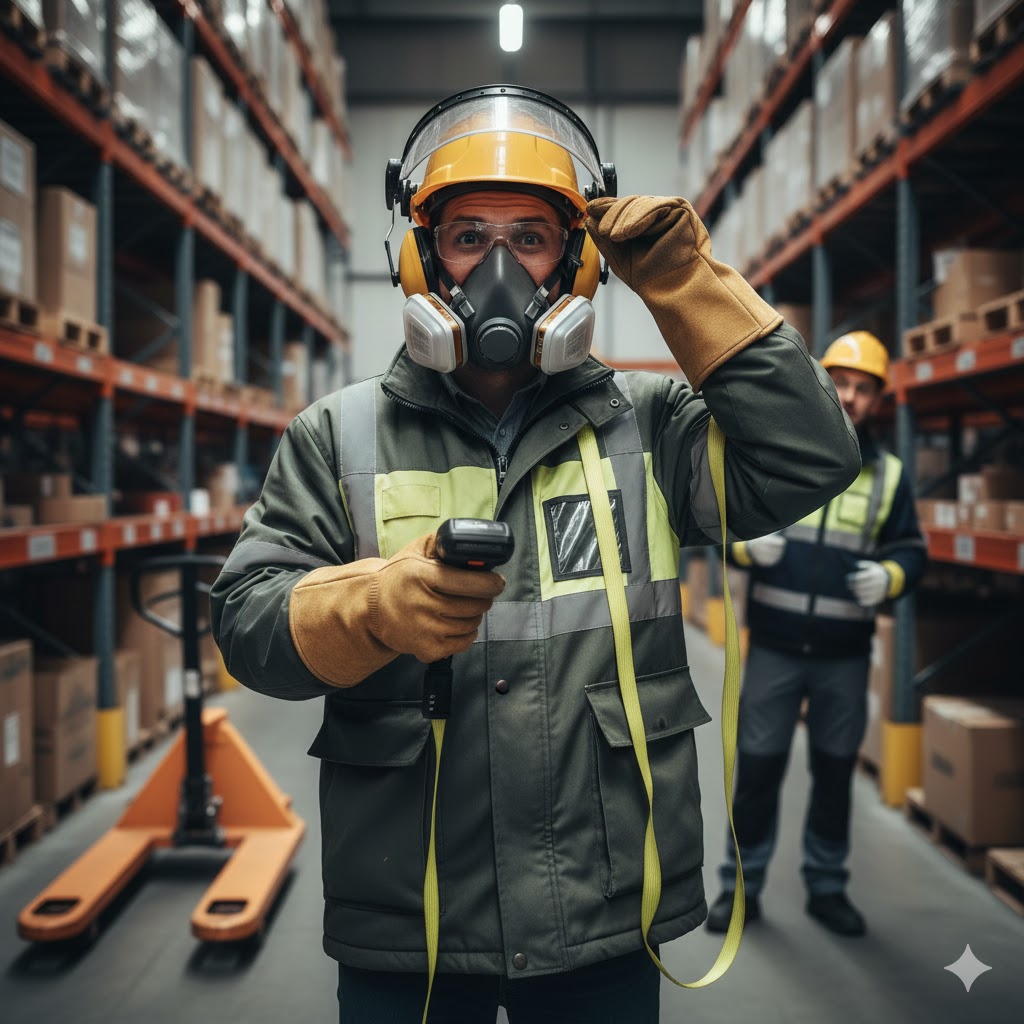
Many people believe that the more personal protective equipment (PPE) they wear, the safer they are.
Help helmets, protective gloves, safety shoes, goggles, wrist guards, knee pads… they feel they must be fully equipped to be considered “safe.”
However, in real warehouses and logistics sites, the situation is often quite the opposite: some seemingly safe protective gear is quietly reducing efficiency and even creating new safety hazards.
This article will discuss, from a practical perspective, the three most common types of “overprotection” in warehouses, and a more reasonable approach to choosing PPE.
What is “Overprotection”? Is it really safe?
Before delving into specific cases, let’s clarify a concept.
Overprotection does not mean “no protection needed,”
but rather that:
the level, type, or method of wearing protection significantly exceeds the actual work risk requirements,
and consequently affects operation, judgment, reaction, or comfort.
In warehouse settings, overprotection commonly manifests in the following ways:
- Using high-specification gloves uniformly for the sake of “good-looking inspections”
- Ignoring job differences and applying a one-size-fits-all approach
- Fear of responsibility, preferring to provide more rather than less
The result is:
- Employees find it troublesome and choose not to wear them
- Operations become awkward and movements become distorted
- Protective equipment becomes a “formalistic prop”
Overprotection ①: High-strength protective gloves actually make operations more dangerous
This is the most common and easily overlooked problem in warehouses.
Common Scenarios:
- Ordinary picking, barcode scanning, and labeling workstations
- are uniformly issued heavy gloves with high cut-resistant ratings
- The gloves are stiff, thick, and have poor breathability
While it may seem like a minor issue, it poses many hidden dangers.
- Difficult to grip, making cartons and goods more likely to slip.
- Barcode scanning is insensitive, requiring repeated adjustments
- Fingers become less dexterous, making small-item handling more prone to errors
- In summer, the sweat and heat cause employees to frequently remove and put on gloves, resulting in inconsistent protection
What was originally a low-risk workstation becomes a new risk point due to “overly heavy protection.”
A More Reasonable Approach
- Differentiate Protection Levels by Work Process
- Picking and Scanning Positions: Prioritize Slip Resistance and Flexibility
- Handling and Cutting Positions: Consider Cut Resistance and Impact Resistance
The core of protective gloves is not “the strongest,” but “the most suitable for the action.”
Overprotection ②: Wearing Helmets 24/7 Regardless of the Situation
Helps are indeed important in warehouses,
but the question is: are they required in every area and at all times?
Common Practices
- Mandatory wearing of helmets throughout the entire warehouse
- Including office areas, low-shelf areas, and packing areas
- Even without the risk of working at height
Actual Problems
- Employees develop a “going through the motions” mentality
- Frequent removal and re-wearing, improper wearing
- When helmet quality is poor, it feels stuffy, heavy, and unstable
- Areas that truly require protection are neglected
When helmets transform from “risk protection tools” into “uniform requirements,” their safety value actually decreases.
A More Reasonable Approach
- Identify high-risk areas: high-bay racking, forklift aisles, loading and unloading areas
- Low-risk areas can be managed flexibly
- Instead of mandatory enforcement across the entire warehouse, focus on strict enforcement in key areas
The key to protection is not “how long to wear,” but “wearing it in the right place.”
Overprotection ③: Protective shoes “the harder the better,” ignoring comfort
Protective shoes are among the most frequently used personal protective equipment in warehouses,
and are also the easiest to be “overprotected.”
Common Misconceptions
- Uniformly using high-grade steel toe caps and puncture-resistant soles
- Not differentiating between handlers, pickers, and inspectors
- Ignoring weight, breathability, and comfort
Real Consequences
- Shoes that are too heavy increase walking fatigue
- Employees changing shoes privately or not tying shoelaces
- Prolonged standing causes foot discomfort
- Increasing the risk of slipping and tripping
A pair of protective shoes that you “want to take off” is itself a safety hazard.
A More Rational Approach
- Choose Different Levels Based on Job Roles
- High-Frequency Movement Positions: Lightweight and Anti-Slip Priority
- Heavy-Object Handling Positions: Further Enhanced Protection Against Impacts and Punctures
- Fitness and Size Completeness are Crucial
Truly good protective shoes are the ones employees are willing to wear every day.
Why Does “Over-Protection” Easily Occur in Warehouses?
In summary, there are usually only three reasons:
- Focusing only on standards, not on the actual situation
- Fear of responsibility, not fear of efficiency loss
- Disconnect between the procurement and use of personal protective equipment (PPE)
But safety is never achieved by “piling up equipment,”
but by a reasonable, continuous, and correctly used protective plan.
How to Choose PPE? Remember These 3 Key Words
If we were to summarize the selection logic for warehouse PPE in one sentence, it would be:
Suitability is more important than completeness.
Remember these three key points:
- Matching Scenarios: Different processes, different risks
- Balancing Efficiency: Doesn’t hinder movement, doesn’t create burdens
- Increasing Willingness to Wear: True protection is when employees are willing to wear it
Summary: More protection isn’t always better; it’s about just the right amount.
In high-frequency work environments like warehouses, over-protection is just as dangerous as under-protection.
Truly mature occupational safety management isn’t about making employees “look safe,”
but about ensuring they—can wear it comfortably, use it smoothly, and work steadily.
If you’re re-evaluating your warehouse’s occupational safety configuration, consider starting by reducing one instance of “over-protection.”
Leave a Reply